
Prayer in Special Circumstances
Prayer in Special Circumstances
In the Friesian Daily Paper dated May 31, 2003, Prof. Dr. K. Runia wrote about the question of office-bearers concerning the need to lead in prayer at the conclusion of a home visit:
In my opinion, prayer at the conclusion of a home visit need not be viewed as a law of the Medes and Persians. Naturally, older people in particular will expect it from us, and so we will satisfy their expectations — unless there are particular reasons for not doing so. It can happen that the whole atmosphere of the conversation is such that you, as “visitor,” are unsure whether it is upbuilding for you to end with prayer. It would appear best, in that case, that you honestly approach the problem by saying, “I truly don’t know if I am doing what is right if I conclude with prayer,” or “I don’t know if you would value our praying together.” The experience of many office-bearers is that at that moment, the truth of the matter really comes out!
At the Sickbed⤒🔗
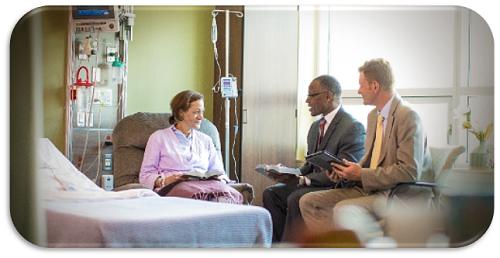
At the sickbed, I think prayer is much harder because it is such a sensitive situation. In the first place, we are dealing with a concrete situation of need. In the second place, it is a very unbalanced situation: as a healthy person you come to someone who is sick. This is a delicate situation. Exactly here the ground rule of any pastoral conversation is doubly important: listen, listen, and listen again. Here I come first as a fellow believer who is willing to be receptive to the other person and is prepared to hear from the sick person how he or she is dealing with the sickness.
It is therefore totally possible that the visiting office bearer receives more than he gives. In my own congregation, this has happened to me many times. Through the conversation, I became much richer.
It also applies here that prayer follows the conversation. If all is as it should be, the reading of Scripture directly follows the conversation. In our concluding prayer we can pull together both threads: the scripture reading and the content of the conversation. At the same time we will lay the concrete needs of the patient before the Lord, the person’s conflict, his or her anguish and doubts, but also his or her hope and expectations.
The Terminal Patient←⤒🔗
The situation can at times be very difficult; for example, when it concerns a terminal patient. It becomes even more difficult if the patient himself is not aware of it, or if denial has become his response. In this case we must be extremely careful; prayer is not the time or place in which to share this information. So, what can we do so as to not fall into superficial generalizations? It is my opinion that in such a case we can only — in childlike faith and trust — commend the patient with his or her cares and needs to our Lord God. The Lord above knows far better than we do, what the sick person needs!
Besides, it doesn’t really matter what we think when we view the situation; it is about reading and interpreting the feelings of the sick person. We do not need to ignore any of those feelings in our prayer. We may bring it all before the Lord — the feelings of anxiety, of disappointment, of despair and of anger. We may lay it all before the throne and before the Father’s heart.
Naturally, the question recurs here: must we pray at each visit to the sick? I think that the answer, as a rule, has to be Yes. Usually the sick person will expect it. Again, there can be situations where there is so much aggressiveness and bitterness that one may not know whether it is of benefit to pray. Also here, the rule is: speak about it honestly. Ask, “What do you think about it? Do you value our praying together?”
Death←⤒🔗
A third exceptional situation occurs when someone in the ward has passed away. Must the elder go? I think so. I think we must go as quickly as possible for a few minutes. What I would do in that case is discuss it briefly with the minister (so that we don’t go together or immediately following each other). The first visit should be short since it is a very busy time for the family. Much needs to be arranged. Depending on the situation, it is not always necessary to pray with the family at this first visit. We can assume that the minister has already done so.
Much more important than this first short visit is the follow-up care. After the funeral has taken place, the busyness is over, and the visiting family has returned home, many people experience a dark emptiness. At this time the real emotional problems often emerge. This is the time to visit them. Visit them regularly (how often depends on the situation). Also with these visits, the first rule is: listen!
Personal Prayer of Intercession←⤒🔗
There is one more point that I would really like to emphasize. We are not finished when we have prayed with the one whom we are visiting. After we leave we retain a task, namely, that of intercession for the person. Perhaps this already begins as you are walking, biking or driving home. Your mind goes back to the visit and to the people whom you visited; spontaneously you begin to pray for them.
Such intercession need not always be very official. We can think about them while we are working, milking cows, at the factory, vacuuming the house, or doing dishes. We think about them and mention their names in our hearts and minds before the Lord. There is no better place. Nowhere else will they receive better care than in the mighty hands of our heavenly Father.
Add new comment