
Why Would a Christian Sing?
Why Would a Christian Sing?
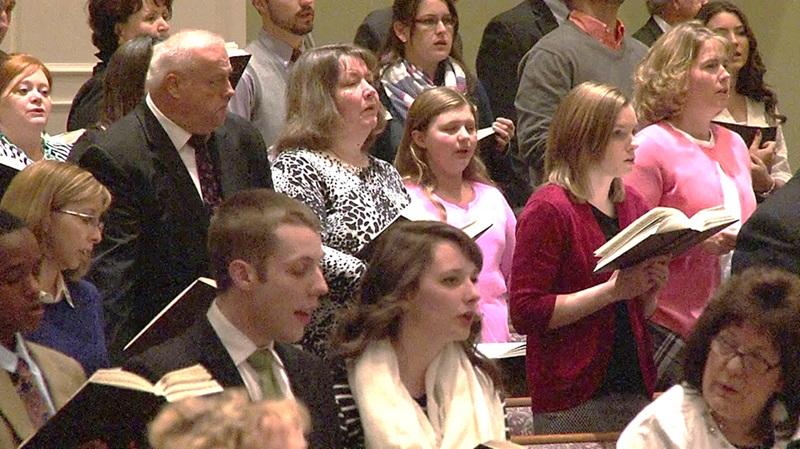
Recently Ontario’s provincial government (the jurisdiction where I live) allowed the opening of centres of worship, including our church (be it to thirty percent of the seating capacity). After some twelve weeks of lockdown in an effort to contain the spread of the novel corona virus, we were certainly more than eager to return to church. That eagerness was clearly demonstrated in how we sang. It was good to lift up our voices together in praise of our Lord and Saviour!
A week later word came out that perhaps worshipers should not sing; singing, it was suggested, spreads the virus. I’m not qualified to weigh the arguments for and against singing in the context of COVID; thankfully the documentation from the Ministry of Health left the matter of singing in the freedom of local leaders. It meant that we in our congregation could keep singing – and we did, eagerly.
That little episode, however, does raise the interesting question: why do we sing to begin with? Just because we enjoy it? Or might it be that the Lord wants us to sing? If so, why?
Perhaps you say: of course he does – and then appeal to various times the psalms tell us to “sing to the Lord a new song” (Ps 98:1; cf Ps 33:3; 40:3; 96:1; 149:1). Isn’t that clear enough?
Well, no, I don’t think it is. Yes, the psalms are inspired – but the psalms are people speaking to people (as opposed to a direct command from the Lord as it came, for example, through Moses). So, we’re back to the question: why does the psalmist tell his fellow Israelites to “sing to the Lord a new song”? By what authority can he give that instruction?
The question is so intriguing, simply because, in all the commands God gave to Moses concerning the building of the tabernacle, and the worship details the people were to follow in the tabernacle, there is not a single reference to singing! Yes, Miriam led the people of Israel in song after Pharaoh’s army was drowned in the Red Sea (Exod 15), and Moses taught the people of Israel their “national anthem” just before he died (Deut 32), and the Book of Psalms even has a psalm written by Moses (Ps 90), but the worship God commanded surrounding the tabernacle in the desert was a completely silent affair in relation to music and singing. The people saw the sacrifices, they heard the words of priests and Levites (including their teaching and the blessing), but the Lord gave them no space to respond in song. That makes the instruction of one Israelite to another in Psalm 98 – to “sing to the Lord a new song” – so striking.
 ⤒🔗
⤒🔗
David←⤒🔗
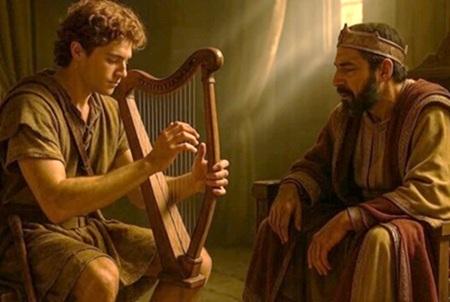
Singing first appears in Israel’s worship in the days of King David. After he was securely enthroned in Jerusalem, he set up a tent in Jerusalem for the ark of God and organized a day when the ark would be carried into the city to its new resting place. The Levites “carried the ark of God on their shoulders,” according to the divine prescription. Meanwhile, other Levites were appointed “as the singers who should play loudly on musical instruments, on harps and lyres and cymbals, to raise sounds of joy” (1 Chron 15:16). That raises the question: why did David appoint singers at this point in history? Or to put the question more sharply: why did the Lord God prompt David (1 Chron 28:19) to appoint singers now?
The ark←⤒🔗
Through Moses the Lord had instructed Israel to build an ark, complete with a mercy seat. This ark functioned as the throne of God in the midst of his people. It was positioned in the back of the tabernacle, in the room known as the Holy of Holies. As the people were en route to the Promised Land, the Lord appointed the Levites to carry the ark as the people journeyed. In fact, during their travels, the Lord went before them – a reality made very visible by the Levites carrying the ark in front of the people (Num 10:33). So when Israel went to cross the Jordan, the Levitical priests entered the riverbed first – and immediately the waters of the river stood in a heap upstream so that the people could enter the Promised Land (Josh 3). The battle, after all, was the Lord’s.
Once the people conquered the Promised Land and settled in it, the ark (with the tabernacle) was set up in Shiloh. But that did not last; in due time, Hophni and Phinehas, the two apostate sons of the high priest Eli, carried the ark to the battle to ensure victory against the Philistines. That effort, of course, did not work; the Philistines captured the ark. Eventually they sent it back to the land of Israel, where the people placed it in the house of Abinadab in Kiriath-Jearim. The tabernacle, meanwhile, was rescued from Shiloh and set up in Gibeon. Clearly, the ark had thus far not come to the end of its journey.
With David now securely on his throne – and so the people well and truly settled in their land – the time had come for the ark of the Lord – and hence the Lord himself – to be settled in the Promised Land. The place where the Lord had chosen to make his home (Deut 12) was Zion, that mountain peak in Jerusalem (Ps 132:13f). From now on, Levites would no longer need to carry the Lord’s ark on their shoulders as it journeyed from place to place.
That’s the setting in which David instructs the Levites to sing.
Why, then, should worship now include singing? With the ark coming to Jerusalem, there is progress in redemptive history; now, finally, Israel’s true King is settled in his resting place, enthroned in Zion. The Levites should no longer carry the ark of God (and hence symbolically God himself) on their shoulders; they now may carry God in their songs of praise. And not just the Levites should bear the Lord on their praises, but all Israel should join in magnifying the Lord in their songs. As Psalm 22:3 has it: the Lord is “enthroned on the praises of Israel.” That’s why in the psalms the one Israelite enjoins the other to “sing to the Lord a new song!” God is enthroned in Jerusalem, King among his people, never to be dislodged – and so it’s right and proper for his people in worship to carry him aloft in songs of praise and so to magnify his greatness in their jubilation.

Jesus Christ←⤒🔗
With the coming of Jesus Christ, God’s presence among his people has been made even more secure. It’s recorded that, as Jesus carried out his earthly ministry, he joined his disciples in singing (Mark 14:26) – and thereby lifting up God’s holiness in song. Then he went to the to cross, hardly the place for joyful song. But he arose from the grave, he ascended into heaven, and entered his final resting place as he took his seat at God’s right hand. With Jesus thus enthroned, never to be dislodged, there is every reason for every creature in heaven and on earth and under the earth to burst forth in worshipful song (Rev 5). Paul and Silas in prison understood that, and so, though their feet were securely fastened in the stocks, they sang heartily in the dead of night. The apostle also directed the saints of Ephesus to make it their business to address one another “in psalms and hymns and spiritual songs, singing and making melody to the Lord” (Eph 5:19). Christ is exalted, he is infinitely worthy to be carried aloft on the praises of all creatures; let there be song in all the world – and especially in the midst of his redeemed!
Today←⤒🔗
So, it’s clear too: singing is so vital to being church! Christ Jesus has arrived, and he’s enthroned, never to be displaced to another location. So, the church joins the creatures of heaven and of earth and heartily joins in songs of worship to carry aloft the glorious name of the King of kings.
And of course, Christians do not limit their singing to church. In the home, in the car, at work – always Christ is enthroned, he’s arrived at his sovereign destination in the heavenly Zion; so we’ll give voice to our jubilation in songs that bear up the name of Jesus Christ before all the world.
Add new comment