
Preaching Today!
Preaching Today!
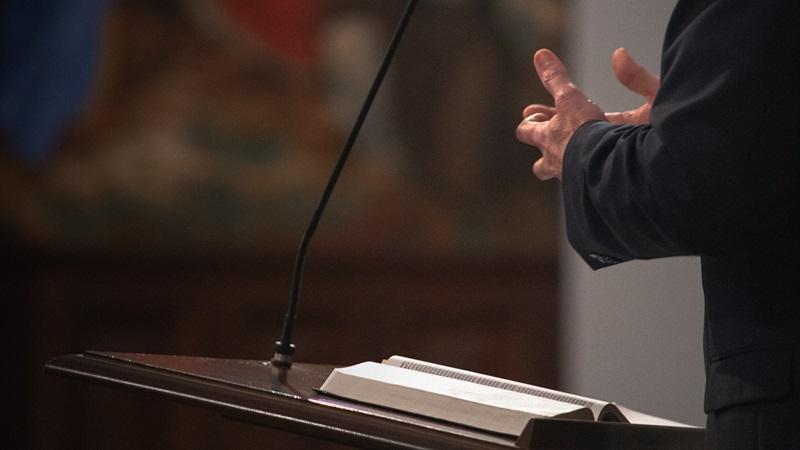
In the area of preaching, shifts are taking place; these shifts raise questions. Is preaching, as such, still happening? One can only wonder. I suppose that I could address this question by initiating a discussion of specific sermons. Actually, people send me sermons quite regularly, accompanied with a remark: this is how sermons are preached nowadays.
Alternatively, I could also profile some of the criticism people submit and try to evaluate that criticism. But I won’t do that either. In my opinion, it is important, first of all, to explain what preaching actually is. And then focus more specifically on the question that follows: what is Reformed preaching? It’s important to first establish that focus clearly (again) to be able to answer the question: what is the state of preaching today?
What is preaching?⤒🔗
Let me begin at a very basic level. Reading from Scriptures is a regular part of the church service, and this reading normally takes place before the sermon. That aspect of the liturgical order tells us two things. In the first place, the sermon is related to that Bible reading, and that Bible passage has a specific role. Traditionally, it’s been the assertion that the Bible reading is explained in the sermon. There’s more, however. In the current situation, there’s also going to be an application and an appeal to the hearers. Though this description of preaching has its drawbacks, it does indicate clearly that preaching is more than the reading of the Bible.
The second thing that can be said of the church service: preaching is not simply reading a passage from Scripture, nor is it the retelling of a passage from the Bible preaching. A crucial feature of a sermon is that it has an application. What does that mean? I cannot articulate this any better than Prof. Dr. K. Runia1 once did. The basic pattern of the sermon, he says, is that someone proclaims salvation to me on behalf of God and appeals to me to accept this salvation and practise it. Runia calls this the “indispensable and essential element” of the sermon.2 In other words, a sermon distinguishes itself from the reading of Scripture at the point that a minister proclaims a concrete application that is focused on the congregation.3 In this context, the question whether a sermon is still being preached can be defined further: does the sermon still contain a concrete claim rooted in the Bible passage that was read earlier and is this directed to me? Am I being challenged, and called upon to do something? Does he direct an appeal to me?
Problem←⤒🔗
When the description of a sermon is expressed in the above fashion, it will become clear that, today, we may be confronted by a problem. The other day I heard a colleague say: “In a sermon, I don’t dare to say anymore: ‘Thus says the Lord!’ Why not? Well, we’ve discovered that everything is now a matter of interpretation. So, we have to be careful; we are children of our time under the influence of our culture. This culture is what determines our interpretation. We must be wary about being judgemental.” More and more people today have embraced this mode of thinking. Last year a Christian periodical placed interviews held with three people who said they were Christians but did not go to church (anymore). One of them explained why: “I have a particularly difficult time with the certainty with which ministers say things from the pulpit as if the minister or pastor knows exactly what God’s intention is for me, or for our lives.”

What the interviewee continues to say is insightful: “Rather regularly I hear the expression, ‘The Bible is quite clear about this.’ According to me, the Bible is not clear about anything, which is exactly why there are so many different views and types of churches.”
The above statement provides us with the core of this line of thought. Doesn’t this thinking appear to make sense? The interviewee has appeared to connect us with sentiments that we may also experience. With regard to the same Bible text, it’s possible to present different things. It simply depends on your perspective. Different interpretations are possible, and, therefore, who can say that the preacher is correct in what he tells the congregation, claiming that it’s based on the Bible? Is an appeal to another interpretation even possible?
Is everything simply a matter of interpretation?←⤒🔗
As logical as this above reasoning may sound, there is, however, a fallacy here. The fact that with the same Bible text you can say different things does not mean that the text is unclear or that you can do anything at all with that text. Compare this problem with the recount of a car accident: Several people have seen it. But everyone has his own story about that same accident. In those stories, people tell their personal view on the matter. To say it in a more complicated way: we must not allow different perspectives on the truth to be confused with a fundamental disagreement about what is factually true.4 When we apply this principle to a Bible text and a sermon, it’s possible to look at a Bible text from different sides and then come with a different appeal to the congregation. That is also why two sermons on the same text can be quite different.
Now, let’s apply this problem of perspective to a Bible text and the sermon. The story in Luke 7, about the woman who anointed Jesus, can be viewed from the perspective of the woman, what she does, and at how the Lord Jesus responds. If a preacher takes that approach, he can also proclaim to us, as Jesus proclaimed to the woman: your sins are forgiven – if you believe.
Another possibility is to look at this story from the perspective of the Pharisee, Simon, and his guests. What moves them, what do they think, and how does Jesus respond to them? From this perspective, the preacher will appeal to the congregation in different way: i.e., we should know and realise that we have been forgiven much and that when we realise that we have this grace, it should inform and motivate our actions.
The example from Luke 7 shows us that there are several possibilities. Those different perspectives also provide the reason why sermons can differ from each other. What is important here, however, is that the appeal in the pastor’s sermon or the application which comes to me as hearer is legitimate. In other words, has the preacher done justice to the text in the light of the immediate context and in the light of the whole Bible? The hearer can check it out and verify this, as the people in Berea did. Paul had preached a sermon there in which he proclaimed the gospel. Then you read that the people in Berea were “examining the Scriptures daily to see if these things were so” (Acts 17:11).
This Berean situation also rings true today. When the preacher directs an appeal in a sermon based on a Bible text, then he has interpreted this text in a certain way. Does this mean that there can be a misinterpretation? Of course. Consequently, this may mean that a preacher may speak bold-faced words that do not stem from the text. This problem has occurred in the past, and it can still happen today. That is why it is important that the hearers can examine what the preacher said in his sermon to hold him accountable, as the people in Berea did: is the interpretation that the preacher presented to the congregation in accordance with God’s Word? In contrast to the people in Berea, who could only access the Old Testament, we also have the New Testament containing the gospels and the apostolic writings. That situation requires that the hearers have knowledge of the whole Word of God. Only in this way can the hearers judge whether justice has been done to the text and to the Bible as a whole. Or they must determine whether the text has been misused and that there’s a misinterpretation.
This thinking should not be done from a motive to “settle the score with the preacher.” Rather, the Berean approach is to serve the pastor, that he will explain the text in the sermon as clearly as possible so that the message he delivers (the appeal) will be justified on the basis of the pertinent Bible text and in the light of the whole Bible. Only in this way can they judge whether justice has been done to the text.

Reformed preaching←⤒🔗
We now come to the next question.
In response to the question – what is preaching? – it will be necessary to go into more detail. Why? This additional description is directly related to the fact that we are Reformed churches. Before ministers are permitted to preach, it is still a prerequisite that every minister must officially subscribe to the Three Forms of Unity. And that’s not a formality: their signature declares that as a preacher they subscribe to the Reformed doctrines; that has irrevocable consequences for the preaching. The question is then: what are the consequences of this subscription? Or in other words, what is characteristic of Reformed preaching?
In the first place, Reformed preaching is characterised by the Reformed way of reading the Bible. I have written about that characteristic earlier in another context;5 therefore, I will only summarize it here. The Reformed way of reading the Bible finds its basis in our confession in which we hold that the Bible is the revealed Word of God as written in the Scriptures (BC, Art. 3). When you’ve subscribed to this confession, this reality means that you will treat the Bible with the utmost care. You are constrained from self-serving interpretations of the Bible. That is why you look at the text in its context and then you proceed from the text to the whole Bible and back again, in the knowledge that God cannot contradict himself. In all this, the apostolic teaching is our guide. The apostles are our witnesses and teachers. In the words of the above apostles and teachers, we are bound by their perspectives on the truth. Finally, it is important to have an eye for the development of the history of salvation and the central place of Christ in this redemptive history. A Reformed minister has respect for this great narrative of the Bible. Unavoidably, therefore, this consideration and respect will be reflected and heard in the sermons he delivers.
In the second place, Reformed preaching is concerned with the conviction, summarised concisely by Luther, that we are “at the same time both sinner and righteous.”6
Salvation←⤒🔗
This conviction means that a sermon is much more than a moralising story: a moralistic talk in which attention is mainly focused on what is, or what is not is not allowed. Preaching goes much deeper. Of course, the sermon may proclaim what God says and what he commands. Sometimes there can be an application referencing what is or is not allowed. But that will always be in a larger context, i.e., in the context of our salvation. Preaching is the means to bring us to salvation, as Calvin once said. After all, our salvation is not a simple announcement that you only have to have heard once and needs no repetition. In this sense, the Bible is not to be compared to a novel or to a movie. Reading a novel or watching a movie once is usually enough. Of course, you can read novels or watch movies several times. But at a certain point you know the plot and the various plot twists.

Our salvation is not a reality of which we take possession: i.e., that once and forever God has forgiven me all my sins and that from now on I am no longer a sinner anymore, but a righteous one forever. For a good reason, the Lord Jesus teaches us in the Lord’s Prayer to ask for forgiveness and to ask for the power of the Holy Spirit to stand firm in temptation. As believers, we are sinners until we die (cf. Rom 7:24-25). Because our sinfulness is a reality, again and again, we must be called to reconcile ourselves to God. As Paul also says to the church (!) in Corinth: “On behalf of Christ we ask you: Be reconciled to God” (2 Cor 5:20). Preaching stands in the context of what Paul calls the “ministry of reconciliation.” In preaching, “it is proclaimed and publicly testified to each and every believer that God has really forgiven all their sins for the sake of Christ’s merits, as often as they by true faith accept the promise of the gospel” (HC, LD 31, Q/A 84). The Canons of Dordt therefore say quite correctly that the promise of the gospel “ought to be announced and proclaimed universally ... to all peoples to repent and believe” (CoD, II/5).
What is the hallmark of Reformed preaching? That an appeal is proclaimed to the congregation, based on the conviction that the congregation is both righteous and sinful. This appeal does not get bogged down in moralism (you must do this or that). Nor is the appeal to be characterized by the attitude: we’ve got it all together (don’t worry, we are reconciled). Nor should this appeal be invalidated by pretending that no truth exists anymore and that everything is only a question of interpretation. The appeal is determined by the fact that the promise of the gospel must be presented to us again and again and that we must appropriate these promises again and again. In this way, the sermon is a means of grace, bringing us salvation.
One of our Reformed ancestors, Theodorus Beza, expressed the preaching of this promise of the gospel in his confession as follows: “The Holy Spirit ... uses this outward preaching as if it were a conduit. In this way, he can ... penetrate into the depths of the spirit in order that, solely and simply by his grace and goodness, he gives the children of God the ability to grasp and understand this great mystery of their salvation through Jesus Christ. In this way, he also renews their thinking... Moreover, he corrects and changes their will.” 7
Building blocks←⤒🔗
Is preaching still happening? Although the discussion about the sermon is timeless, in our time this question has been posed by quite a few people. With what I have presented, I hope to have provided the first building blocks to begin a conversation with one another.
Add new comment