
A Funeral Procession Halted
A Funeral Procession Halted
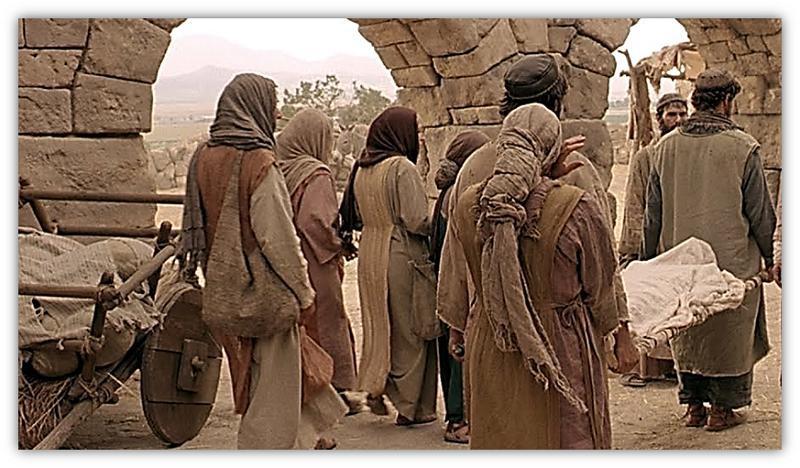
Soon afterward He went to a town called Nain, and His disciples and a great crowd went with Him. As He drew near to the gate of the town, behold, a man who had died was being carried out, the only son of his mother, and she was a widow...
Luke 7:11-17
One of the pictures etched in my mind from the time of the COVID-19 pandemic is that of a procession of Italian army trucks carrying away the bodies of COVID19 victims. There were too many bodies to handle and this emergency measure had to be taken. It was a grim procession, deathly surreal.
Luke 7:11-17 is an account of two processions – a funeral procession leaving the town of Nain to go to the cemetery, and the procession of Christ and the crowd with him approaching Nain. A dead man was at the head of the one procession, Christ was at the head of the other. The one procession represented death, the other life. This is a study in contrasts.
As he approached the town, Christ was confronted by the misery of death. A young man who had died was being carried out, the only son of his mother, and she was a widow. The woman – a widow – had already lost her husband. Now her son had died too. It was one sorrow after the other for this woman as she had to bury another loved one. This son was still a young man. Parents don’t expect to bury their children regardless of age, but especially not when their children are still young. The death of a child is always heart-wrenching. And this was her only son. Sons were important in Israel because they passed on the family name and because they were supposed to provide for their widowed mother; all of that was gone with the death of her only son. The future looked very bleak for this woman as she headed toward the cemetery. As was customary among the Jews in those days, the mourners would have been wailing loudly.
Normally people give funeral processions right of way. But not Christ. He was moved with compassion for the mother and said, “Do not weep” (Luke 7:13), and then deliberately touched the bier – let’s say the coffin – thereby becoming unclean. Anyone in Israel who came into contact with death would be unclean (Num 19:11-22), because anything to do with death was a constant reminder that sin had come into the world. Death defiled because sin defiles.
The message of the gospel is that Jesus Christ came into the world to take our uncleanness, sin, and curse upon himself and to carry it all to the cross of Calvary. Touching the young man’s coffin symbolized this. As Paul writes, “For our sake he made him to be sin who knew no sin, so that in him we might become the righteousness of God” (2 Cor 5:21).
Then Christ showed that he came into the world to break the power of death when he raised the young man to life. Sorrow turned to joy for the mother and the crowd! This pointed ahead to the fact that, by his death and resurrection, Christ would triumph over death and the grave. Jesus Christ is the Saviour from death and the Lord of life!

For Christians, the curse of death has been removed because of Christ’s death and resurrection. Death is entrance into eternal life. And the dead shall be raised incorruptible and live forever in body and soul – not to die again as the widow of Nain’s son would die again.
We share in this good news by grace through faith. The people in Christ’s day responded by saying that Christ was a great prophet (Luke 7:16). That’s all. What is your response to Jesus Christ? Do you believe in him as Saviour from death and Lord of life? If so, then a funeral procession of any kind does not have to make you deathly scared because you have the deep and only comfort that you belong with body and soul, both in life and in death, to your faithful Saviour Jesus Christ (HC, LD 1).
For further study⤒🔗
- This passage is the first of only three times that Christ raised someone from the dead. What are the other two instances? Look up Luke 8:40-56 and John 11:1-44.
- How might trials and temptations strengthen us to rely more and more on God’s faithfulness in Christ?
Add new comment