
Counting COVID as Joy
Counting COVID as Joy

What were your thoughts when you saw the heading? Did it cause you to wince, thinking that joy and COVID really do not fit in the same sentence? Or, upon brief reflection, did the heading, though a bit startling, make you think of a passage such as “Count it all joy, my brothers, when you meet trials of various kinds...” (James 1:2).
I would hope that it was the latter. It is that angle that will be the focus of this article. It merits reflection so that we may be strengthened in our faith as we continue to experience the effects of the COVID virus, even if not directly, but in the efforts made to contain it.
James and Romans⤒🔗
To start, it will be helpful to quote the words of James in full. We read, “Count it all joy, my brothers, when you meet trials of various kinds, for you know that the testing of your faith produces steadfastness. And let steadfastness have its full effect, that you may be perfect and complete, lacking in nothing” (James 1:2-4). Paul speaks in a similar way in Romans 5, “But we rejoice in our sufferings, knowing that suffering produces endurance, and endurance produces character, and character produces hope, and hope does not put us to shame, because God’s love has been poured into our hearts through the holy Spirit who has been given to us” (Rom 5:3-5).
Neither James nor Paul specify what trials or sufferings they had in mind. We might be inclined to think of trials related to our faith in the form of hostility and persecution. We need not limit it to that. The LORD tested Abraham by letting him experience famine not long after he entered Canaan. He tested Old Testament Israel in the wilderness by letting them hunger, to see what was in their heart (Deut 8:3). In sum, all difficulties in life can be seen as trials and suffering.
Difficulties due to COVID←⤒🔗
When we think of our situation due to COVID, thankfully it is not the case of having to face hunger or be in want of the various necessities of life. We are also not faced with persecution for our faith. The gospel can still be proclaimed. Our trials and suffering are due to restrictions placed upon us by the civil authorities as they seek to contain the spread of the virus. We feel the impact mostly in our social interactions.

This past holiday season will have been rather bleak and lonely compared to other years, when Christmas and New Year’s was the time for enjoying the company of family and friends. We also feel the impact in terms of worship as, at best, only a part of the congregation can gather for worship. In some parts of the country, this may not have been possible at all. Beside not being able to visit whenever we wish with whomever we wish, and not being able to worship whenever and however we wish, we can’t go out for dinner or a coffee with others whenever we wish or go on holidays whenever and wherever we wish. Plus, we are expected to wear masks and practice social distancing. Our daily needs may be provided for, but our lifestyles have become rather cramped, as basic freedom of movement, so long taken for granted, has been greatly curtailed. You could say that we can do our work, but much of what gives us joy in life has been taken away from us. Except for those who have caught the virus and therefore suffer physically, or those who have had loved ones die of the virus, this is how we suffer through the pandemic. Not being able to do whatever and go wherever, that is our trial.
Where’s the joy in this?←⤒🔗
Just reading through a description of our trials and sufferings may cause a bit of a twinge as to the severity of our trials and sufferings. How does it compare to those who lived through two world wars? How does it compare to those who lived through the Barbarian invasion of the Roman Empire in the fifth century, or who lived through regular Viking raiding parties? How does it compare to those who face hunger and starvation, or to those whose lives are threatened because they confess Jesus as LORD? How does that compare to the two Canadians who have languished in a Chinese prison for the past two years? We will leave aside the comparison for now as, for many, if not most of us, this is the most severe situation we have ever encountered.
How can we speak of joy in these circumstances, when so much of what gives us joy in life has been taken away?
We see it when we consider how a time like this is an opportunity to do some spiritual soul searching as to the health of our faith. Trials and sufferings are time to ask what we believe and how much our faith has been absorbed into our whole manner of life.
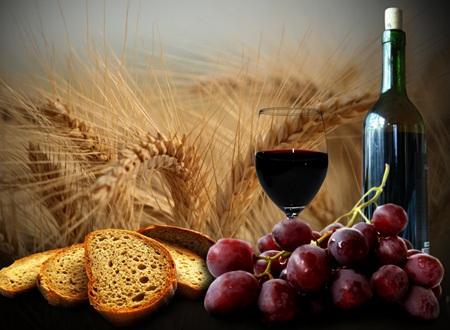
We can do that by looking at our lives in terms of the words of LORD’s Day 1, words learned since a young age, where we speak about our only comfort. That comfort, we confess, is that we belong, with body and soul, both in life and death, to our faithful Saviour Jesus Christ. We confess this is my only comfort because Jesus has paid for my sins and delivered me from the power of the devil. He preserves me so that without the Father’s will not a hair can fall from my head. He assures me by his Holy Spirit of eternal life and makes me heartily willing from now on to live for him. In these words, we find an echo of what David says, for example, in Psalm 4:7, that the LORD has put more joy in his heart than when wine and grain abound. We can also think of the words of Habakkuk, who said that though the fig tree should not blossom nor there be fruit on the vines, and the fields yield no food, he would find his joy in the God of his salvation (Hab 3:17-18). Or we think of Paul telling the Philippians that he counted everything as worthless because of the surpassing worth of knowing Christ Jesus as LORD (Phil 3:8).
 ←⤒🔗
←⤒🔗
Self-examination←⤒🔗
When we take these words about our only comfort and true joy, that of being children of God in Jesus Christ, and now look at ourselves, what are we learning throughout this COVID situation about our faith? Have the restrictions placed upon us to contain the virus flushed out that perhaps we thought too much that our life consisted in the abundance of our interaction with others and the abundance of opportunities to do whatever and go wherever, whenever we wished? Was our comfort and joy in life tied to having our winter break, our spring break, or our summer break? Was our comfort and joy tied to seeing everyone we used to see? This is not to deny that on a human level, all these things have their place and value. We are talking now about ultimate value. What is it that we absolutely cannot do without? If the COVID pandemic helps us figure that out, we can rejoice.
We will realize that there is only one thing we can’t do without, and that is the LORD our God. We think of our confession that our only comfort is that we belong to Jesus Christ. That’s also what led Paul to write as he did in Romans 8 about being more than conquerors through him who loved us. Because of that, he knew that nothing could separate him from the love of God in Jesus Christ. That confidence has given believers throughout the ages the strength to face harsh and cruel imprisonment, finding joy in their relationship with the LORD and knowing that one day they would join him in glory. As our LORD Jesus said another time, they can kill the body, but they cannot kill the soul (Matt 10:28). We are not even close to a situation like that, but it is good to be reminded of such situations to give us perspective and to let the situation we find ourselves in build us up in the hope of the life to come.
Purified and strengthened faith←⤒🔗
When we reflect on the COVID situation, we should ask ourselves if the lesson about our only comfort, our only joy, has sunk in enough. If it has, it might keep us from just praying for a return to life as it was before. After all, that would just put us back to seeking our joy in the things of the earth and overlooking our true joy and comfort. If COVID has forced us to reevaluate our lives and realize our only comfort is that we belong to our faithful Saviour and made us find that he truly is our joy and our strength and all the other things are secondary, then we can count COVID as joy, for it has purified and strengthened our faith.
Add new comment