
Church – State Relations Revisited
Church – State Relations Revisited
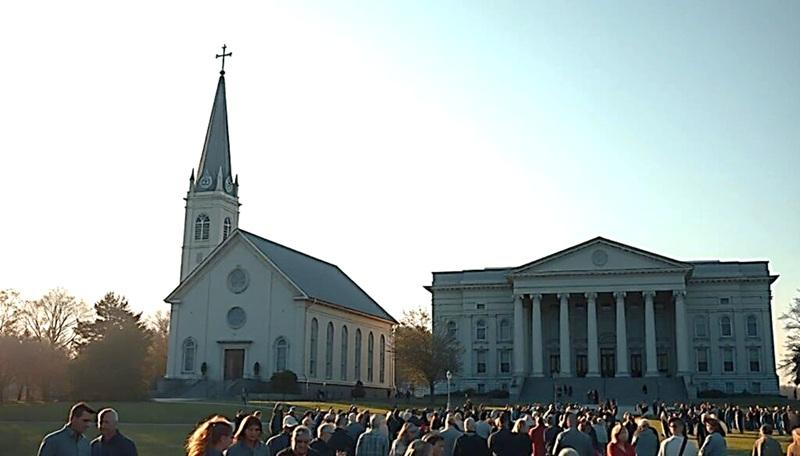
There is little doubt that the coronavirus continues to dominate the news today. Whether one turns on the television or logs onto a computer or tablet, the news is all the same. Disasters may strike here or there, military tension may rise between nations, ugly crimes may occur, no matter what it is, it just does not seem to get the same amount of coverage as the pandemic.
Yes, and when it comes to that coverage, there is a great deal of controversy too. Did China purposely send this plague abroad? Was President Trump negligent not to act sooner? Has PM Trudeau emptied the financial cupboard for future generations? The discussions are often hot and fierce.
Why, even among Christians, there is controversy. Have governments overstepped their legal limits? Are religious freedoms being curtailed? Should churches be allowed to worship freely? How should churches and Christians react in these strange COVID times?
Often the debates wax hot and heavy. Sometimes the comments made are reasoned and well-thought out, while at other times they are off the wall, inflame the situation, and only serve to increase anxiety levels.
All of this means that it would do us good to turn down the rhetoric, as well as take a more objective approach to the current situation. In that connection it may be beneficial to examine the church-state relationship, and what each can or cannot do.
A brief historical look⤒🔗
A brief historic review of this matter soon leads to the conclusion that tensions in church-state relations are nothing new. One has only to think of the times of the early church and whether or not Christians should call Caesar “Lord.” Or what about the Middle Ages and the contest between the Papacy and the rulers of Europe as to who should obey whom? Or what about the days of World War II and the question of whether or not Christians should obey their German overlords or not? Hence, the fact that there are questions and issues about this relationship should not surprise us.
Biblically speaking←⤒🔗
Still, we do well to do more than just examine this matter historically. What about the biblical dimension? Turn to the Old Testament and you will soon come to the conclusion that there is no end to the comments that can be made about the interactions between Abram and Abimelech, Moses and Pharaoh, Elijah and Ahab, Elisha and Naaman, Daniel and Nebuchadnezzar. What is instructive, however, is the fact that the OT always maintains that God is the ultimate Ruler and Sovereign and that all earthly ones need to recognize and obey him. Mock him, ignore him, resist him at your peril (Ps 2). By all means, honour and obey your earthly rulers, but never at the cost of rendering homage to God.

When we come to the New Testament, the narrative changes somewhat. Respect and submission are still Christian hallmarks. Consider the exchange that takes place between the Lord Jesus and Pontius Pilate. Our Lord does not tell Pilate to mind his own business. Neither does he challenge or mock his authority. He remains composed, acts respectfully, and corrects him carefully. Much of the same can
also be said of the apostles when they are arrested and arraigned before the powers that be. Indeed, Peter is even on record as telling his readers, “Honor the emperor” (1 Pet 2:17). Paul elaborates on this in Romans 13 when he tells Christians that they are to “be subject to the governing authorities” (Rom 13:1). Why? Because “those that exist have been instituted by God” and “whoever resists the authorities resists what God has appointed” and, if they are not careful, they will incur “judgment” (13:1, 2).
Article 36←⤒🔗
All of this biblical data served in time as the basis for Article 36 of the Belgic Confession, where Reformed believers are on record as stating, “We confess that, because of the depravity of mankind, our gracious God has ordained kings, princes and civil officers. He wants the world to be governed by laws and statutes in order that the lawlessness of men be restrained and that everything be conducted among them in good order. For that purpose he has placed the sword in the hand of the government to punish wrongdoers and to protect those who do what is good (Rom 13:4).” What one sees here in particular is the clear necessity for government. Without it, lawlessness and anarchy would get the upper hand and evil would triumph. Why? Because of the “depravity of mankind.” Government has thus been given to us by God for our good.
In addition, the people are not just to acknowledge this, they are also to make the task of those who rule over them manageable. Article 36 goes on to remind us that we “ought to be subject to the civil officers, pay taxes, hold them in honour and respect and obey them in all things ... We ought to pray for them...” So, obedience, respect, paying taxes, and prayer are to be the hallmarks of Christian citizens.
Radical Anabaptists←⤒🔗
Still, not all who considered themselves Christians agreed. In the days of the Belgic Confession, both before and after, there were those who disagreed. The radical Anabaptists of the Munster variety refused to recognize the government, resisted taxation, resisted oaths of allegiance, refrained from prayer, and openly defied their rulers. We also had other milder strains of Anabaptism which were still largely negative about those who governed.
Reformed believers, however, disagreed with them. Sometimes the disagreement took on serious tones, as when Article 36 concludes, “We condemn the Anabaptists and other rebellious people, and in general all those who reject the authorities and civil officers, subvert justice, introduce a communion of goods, and overturn the decency that God has established among men.” Unlike the Anabaptists, the Reformed are not “anti” government nor do they approach those in government with suspicion and distrust. We esteem them for their office.
Such regard once stood one of my ministerial colleagues in good stead. When he was called on the carpet by the Chinese authorities, he explained that as a Christian he was not a political radical seeking to undermine authority. He explained that he, along with his fellow believers, confessed and practiced the truth of Article 36. Upon which the Chinese official interrogating him quoted parts of that same article. After further questioning, he was released and urged to register with the government.
Oppressive governments←⤒🔗
While this meeting turned out well, the same cannot be said of all meetings between Christians and those who rule over us. One is led to think back to that incident in the book of Acts where Peter and John were commanded not to speak in the name of Jesus (Acts 4). How did they react? They refused and told the Jewish authorities “we cannot but speak of what we have seen and heard” (4:20). Sometime later, when he was arrested again, Peter was reminded, “We strictly charged you not to speak in this name [of Jesus].” So, what did he say in reply? He declared, “We must obey God rather than men” (Acts 5:29).
The fundamental truth that needs to be upheld here is the truth that for Christians God always comes first. He receives our first love, our first allegiance, and our first obedience. When the government told believers long ago in Roman times that they needed to bow and confess that “Caesar is Lord,” they respectfully declined. Sometimes they did so at the cost of their very lives. Or, should the government tell us today that we need to keep quiet when it comes to such evils as euthanasia and abortion, we will not comply. Or, if the government were to tell us that we can no longer worship the Lord together, we will not bow. In the final analysis, our obedience to the civil authorities is conditional and not absolute. Only God receives our complete and utter submission.
The situation today←⤒🔗
Now, having put the matter of church and state in this context, what are we to think of today and the COVID situation in which we live? Is the government overstepping its boundaries when it insists that churches observe certain limits on attendance? Is it thereby trampling on our religious rights and freedoms? Should Christian rise up and resist these restrictions? Should we have church no matter what?
Before I answer these questions, please enter with me into a certain scenario. Imagine that you are a premier or governor and a new and unknown disease begins to attack and kill the people in your province or state. You consult with the medical
authorities and they tell you that there is lot that they do not know about this nasty illness, although what they do know is that it is easily passed on, that it loves to spread in large crowds, and that it is a deadly threat to all those who have prior medical conditions or are old.

So, what do you do as a caring and responsible premier or governor? You instruct your medical people to prepare themselves as best as they can for the onslaught, even at considerable risk to themselves. At the same time, you tell your citizens that they need to take certain precautions as well. Among them is the need to avoid large gatherings: rock concerts, hockey games, church services, and the like. Why are you doing this? You are doing it in order to protect and safeguard the lives of your citizens, especially those who are weak and vulnerable.
Now, of course, this is not your only possible course of action. You could ignore what your health authorities are telling you and take your chances.
What is easy?←⤒🔗
The point of all of this is that in the current situation it is an easy thing to sit back and criticize or to second guess those who rule over us. It is also an easy thing for us to get all worked up by reading all kinds of scary stuff on the Internet. Some of it may be true, but a lot of it is false and distorted. Who to believe is a huge question in these uncertain times. Unfortunately, all too many side with the purveyors of rumour, half-truths, homemade solutions, and one-sided quotes.
Do those who rule over us have all the facts and are they making all of the right decisions? Of course not. They too are making their share of mistakes. At times they may err on the side of being ill prepared or on the other side of too much caution and regulation. No doubt future inquiries will identify and analyze their mistakes to death. Oh, the wonderful gift of hindsight!
So, what should our approach as Christians be? Pray for those who are in authority over us, speak about them with respect, follow their instructions, and when in disagreement, approach your elected representatives and offer them your best counsel. Realize that they are people just like us, so they will never get it all right, but at the very least give them an “A” for trying to save lives.
Add new comment