
Are Sunday school programs for young children right or wrong?
Are Sunday school programs for young children right or wrong?

Question: Are Sunday school programs for young children right or wrong?
Some of our churches are beginning to discuss (some have already implemented) Sunday school programs for young children, to be conducted during the worship service. Is there anything biblical to suggest that is either wrong or right?
Should our churches be cautioned against it? Or should they be encouraged to send children out of the worship service to a program geared at their own level?
Answer: First of all, Sunday School programs, originally, were not meant for services in which children were addressed and activated during the worship services attended by the parents. Children’s programs that have come into practice as alternative for their attendance in the regular worship service are of a different nature and for a different purpose. Sunday Schools were held outside of the regular worship services and for others than the children of the congregation. When I was a pastor in the church of Winnipeg, the evangelism committee and Sunday School teachers operated a Sunday School before the morning service (which for that reason started at 10:30 a.m.). This Sunday School was meant for children from the neighbourhood with whom there was contact via the parents, advertising, VBS (follow up!), and other ways. In some of the churches of the URCNA I have seen the operation of a Sunday School which is held following the morning service for the children of the congregation. There the teachers follow-up on the worship service (sermon a.o.) and teach the children Bible stories, songs, and crafts.
While the parents socialize with their fellow-members, the children are (happily and actively) engaged in these Sunday School classes.
The question refers to programs for “young children” to be conducted during the worship service. It depends first of all on the actual age of these “young children.” If this pertains to the three- and four- year olds, for instance, who are in the nursery still because they are yet too young to sit still and to sit through the worship service with their parents, then it certainly would be an effective and fruitful pastime to keep them occupied with an activity, craft, story, and song. Just as the parents may be doing at home, it will be a useful way of introducing these “young children” to the practice of listening, singing, and busying themselves with matters related to the service of God.
The “problem” that’s implied in the question, however, probably pertains to the older children for whom sometimes “services” are organized as substitute or alternative to the regular worship service. Then it can happen that children leave the worship service before the sermon begins, and they return for the closing part of the regular service. This, of course, is a different matter and a practice that we should not start in our churches. Then, indeed, there are biblical inferences that teach us the important scriptural notion that the children belong to the covenant assembly of the people of the Lord! From Deuteronomy 29:11 and Joshua 8:35, we learn that the children were taken to the meetings of God’s people and that they were present when his people celebrated their feasts (1 Sam 1:3f.). From Nehemiah 8:2 we may conclude that these children were of an age at which they were “starting to understand,” yet with their parents they shared in the instruction in the Law by the Levites (v. 7). The children, “who do not know this law,” also need to learn to listen to the voice of their God, together with their parents and the other members of the congregation.
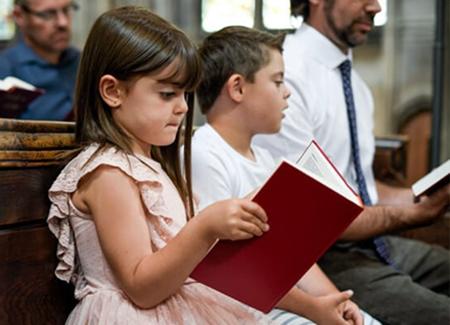
In some churches an alternative to this substitute children’s service was found by addressing the children separately or by introducing the message of the text by way of a children’s version. This, too, is something that’s not found in the Scripture. Rather, we should note that on the one hand the Bible speaks time and again about “you and the children (Deut 4:40; 11:21; 12:25, 28; 30:2), texts in which the children are mentioned specifically, but as children of their parents: your children. On the other hand, we note that Moses or the prophets or the apostles do not address the children directly, but they show the parents what they have to share and instil in their children (often also upon the child’s question, “What does this mean? Exod 12:26; Deut 6:7, 20f.; Josh 4: 20; Joel 1:3). Indeed, for “the promises are for you and for your children. . .” (Acts 2:39).
The parents have the task, therefore, to follow-up on the service and explain to their children what they have learned from the instruction in God’s Word. As I know from experience, then they will also be surprised how much the children pick up and learn to understand. Then in their family devotions as well they can train their children to sit still, participate where they can, and grow in understanding the Word of God! At the same time, it has also been my experience how beneficial it is for the involvement and participation of the children when in the liturgy, where possible, the Psalms they learn for school are integrated in the liturgy.
Add new comment