
The Truth about Transgender
The Truth about Transgender

Just when we think that things could not get any crazier, we hear a story that pushes the moral meter into a zone of extremity which we did not even know existed. For me, one such moment was the determination in early 2020 by a British Columbia judge that a father’s refusal to refer to his daughter as a boy and his efforts to oppose her “transition” constituted “family violence.” This father had gone to court to stop his fifteen-year-old daughter from undergoing hormone injections, arguing that she lacked the maturity to understand the radical and long-term consequences of such injections. He also argued that she had been unduly influenced by transgender activists.
How did the world get to such a state that a father can be threatened with arrest and jail time for the “crime” of addressing his daughter as “she” instead of her preferred “he?” How can it be that one of the first actions of a new president of the United States in January of 2021 was to sign an executive order mandating that trans women athletes (biologically born boys who now identify as female) must be allowed to compete with biological women and girls, despite their physical advantages? How was it possible that J. K. Rowling, the renowned author of the Harry Potter books and a feminist cultural icon, could suddenly face the wrath of activists for saying that being a woman is not simply a pose one can adopt by choice?
Loss of objective meaning and the cult of feelings⤒🔗
To understand these and many similar events, we need to step back for a moment to consider the cultural revolution of the last several hundred years. Only by doing this will we realize that transgender activists have their own logic, one that radically conflicts with those of our Christian confession.
Ever since the Enlightenment, also known as the Age of Reason, the cultural elites of our society have rejected the Bible as God’s revelation of the truth about human nature, human depravity, and human redemption. Despite their rejection of supernatural revelation, however, the thinkers of the Enlightenment continued to embrace the notions of objective truth and objective meaning. For them, the truth about nature and life could be reached through the exercise of reason.
Over time, though, the unleashing of reason and science proved unable to create the expected world of endless progress and abiding peace. Slowly but surely, our civilization lost confidence in its ability to arrive at objective and universally valid ideas regarding morality, history, and society. Bereft now of God’s revelation and having lost confidence in the objectivity of reason, society was left without any external authority to give guidance regarding matters such as human sexuality.
What do you have when God’s Word is unheard and when reason is no longer trusted to produce a common understanding of the world? In short, you have an I-world (think iPhone, iTunes, iPod)! In such a world, every individual is free to construct his or her own meaning. Instead of accepting sexual realities as God-given or at least as grounded in the objectivity of nature (anatomy is destiny), people today tend to see their sexual identity and sexual expression as entirely personal. We get to define our own sexual realities because there is really nothing objective outside of ourselves to which we must or even could conform our lives. It is an iSex world out there!

Even if the trajectory of our own lives as Christians is not the same as that of our society, we all feel the impact of the changed world in which we live. We sense how difficult it is in our cultural climate to challenge people’s self-expression and self-definition. If someone has homosexual feelings, we are made to feel that we can never question them. Similarly, if someone has sexual feelings and personal identity intuitions which do not align with their biological body, the only thing to do is accept what that person is experiencing. Any attempt to “correct” the sexual feelings of another person will be treated as an act of violence to the dignity of a human being. We are not surprised, then, to learn that our national government seeks to prohibit any kind of “conversion therapy.” It would be a violation of the morality of the iSex world.
Responding to an ideology←⤒🔗
How ought we to respond as disciples of Christ to the transgender ideology? The answer lies in three familiar words: creation, fall, and redemption. These biblical words lead us out of the moral solipsism of our culture into the clear light of God’s eternal truth.
In the beginning, says the Bible, God created human beings in binary mode as male and female. The Creator pronounced this distinction within the human family to be definitive and good. Each human being comes into the world already defined by God as male and female. Sexual identity is not a human choice but a divinely determined reality for each of us. What a person feels, whether fleetingly or more enduringly, cannot trump what God has made us to be: male or female.
However, the biblical narrative speaks to us also of the reality of the Fall. Because of the Fall, we do not live in a normal world. Instead, our present world is one of disorder, decay, and death. Because of human rebellion against God, even the material world in which we live is spoiled. Our physical and mental existence likewise has been degraded. We think futile thoughts. We experience feelings of anxiety, depression, alienation, and stress. Left unchecked, our desires would destroy us. Our bodies, our intellect, our feelings, and our desires are all disordered. We are just a shadow of the inwardly harmonious creatures God made us to be!
Compassion but not approval←⤒🔗
Because of what we know about creation and the fall, people who experience gender dysphoria deserve our compassion. They are experiencing a strong degree of emotional, psychological, and relational pain due to their gender dysphoria and that needs to be acknowledged. Nobody is completely sure how or why gender dysphoria appears, sometimes quite suddenly, but for our purposes, this is irrelevant.
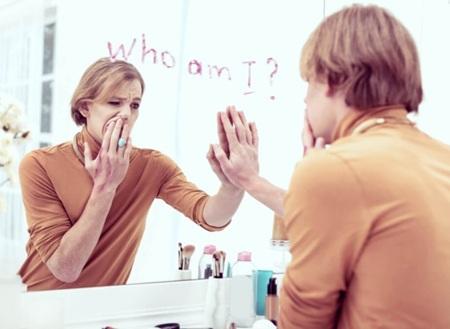
What matters is that we must meet people where they are as they experience unsettling and deeply alarming incongruities between their biology and their mental experience of life. If we confess the Fall and if we are honest about how the Fall manifests itself in our own life as sexual beings, we will have plenty of compassion for individuals with transgender feelings. What they experience is not necessarily reflective of willful disobedience against God but simply a symptom of life in a fallen world.
Compassion, however, does not mean endorsement, nor does it legitimize radical actions such as hormone therapy or surgery or cross-dressing. Instead, we need to keep in mind God’s creational design and, equally, his redemptive purposes. Because God is our Creator and Redeemer, we cannot accept our human feelings as decisive or normative. We do not agree that people can be authentic only as they follow their own desires.
A Christian with transgender feelings must be encouraged to live by faith in our crucified and risen Saviour! As believers, we find our identity not in what we find in our own psyches, but rather in Christ. We are not defined by our sexual feelings, but by our faith union with our Lord and Saviour. He abides in us and we abide in him and so we are belonging-to-Christ-with-body-and-soul people!
Instead of taking our own feelings as normative, believers seek the ongoing transformation of their lives into the image of Christ! Instead of elevating human passions as decisive, we aim to present our bodies as living sacrifices of thankfulness to Christ. Transformation and not normalization is the name of the Christian religion! Powers of the future age are already at work in us to shape us toward our resurrection destiny when at last the effects of the fall will be completely reversed.
At the same time, we are not yet experiencing the fullness of the Kingdom of God and, for this reason, a measure of ongoing dissonance can be expected in our lives. A Christian faith does not in all cases remove transgender inclinations. There is tension between what we are in Christ and what is today the case in a still-fallen world. Such tension demands patience and motivates us to persevering prayer.
Some guidelines←⤒🔗
How do we apply the Christian story of creation, fall, redemption, and glory to the struggles and sins of people with transgender feelings? What do we do when people we know and love in our families and churches become open about their feelings?

First, let us be sure to avoid jokes and ridicule. If you are in so much pain that you are contemplating a form of surgical mutilation to bring relief, it would be devastating to have people making fun of you. In the church, we must not mock people; instead, we grant them space to reveal their struggles and we offer them our loving support and encouragement. A warm and loving environment creates room also for exhortation and warning.
Secondly, if the person manifesting transgender feelings is a child, do not panic. Many adolescents and teens have temporary gender dysphoria. Growing up is not easy! Young people go through tremendous stresses and strains as they adjust to changing bodies and emerging desires. When you add to this the potential pain of social rejection and the complexity of relations between the sexes, you have a volatile situation in which confusing feelings can arise. In the matrix of youthful anxieties, the idea may emerge that one’s problem is a discrepancy between feelings and biology. Embracing a new sexual identity may seem to be the exodus path out of misery!
Thirdly, the church cannot condone cross-dressing, hormone therapy, and surgery as the solution for confused feelings. When there is a disjunction between biology and the mind, the solution is not to change the body and our dress but rather to seek the changing of the mind! Our body is a biological given. Our minds, in contrast, can be changed by the grace and Spirit of God. Old patterns of thinking can give way to those made new by the power of the gospel. Feelings once considered permanent can be overcome by healthier feelings more in line with creation and redemption.
Not iSex but iChrist←⤒🔗
In short, the church must urge all its members to live not by what we naturally are but rather by grace. We must be reminded constantly that our sexual feelings do not define us. As Christians, we must reject the iSex world and embrace in its place the iChrist reality set forth in the gospel. We are defined by our relationship to Christ and so we are to live by the power and grace which is promised to those planted in him. Living a Christ-conformed life is not easy. It is a process which takes effort and time, and it necessitates daily self-denial. This is true for every believer and not only those with unique challenges such as transgender feelings.
Biologically speaking, there is no such thing as a girl trapped in a boy’s body or a man trapped in a woman’s body. Framing human unrest in this way is an understandable but incorrect diagnosis of the problem which, if accepted, closes the door to hopeful change. We are trapped not by biology but by the depravity of sin and only the gospel can resolve the inner tensions created in our lives by the fall. Instead of hormones and the knife of a surgeon, those who experience transgender feelings need the transforming power of the gospel and the severe surgery of the Holy Spirit who makes us new in Christ.
 ←⤒🔗
←⤒🔗
A few helpful books←⤒🔗
Vaughan Roberts has written a helpful primer on the topic. His booklet is entitled Transgender and was published by the Good Book Company in 2016. It is from him that I borrowed the iWorld terminology. In seventy-five pages, he covers in satisfying depth the issue of transgender. He begins with salient observations about our culture and then examines the topic from the perspective of creation, fall, and rescue. The last chapter is entitled “Wisdom,” and seeks to apply the gospel to various situations that might arise in a Christian family or church community including what to do when you have a child expressing transgender feelings. A very readable and recommended resource.
Owen Strachan and Gavin Peacock co-authored a book entitled What Does the Bible Teach about Transgenderism (Christian Focus Publications, 2020). This is also a short book (105 pages), but is a slightly more challenging read than that of Roberts. The writers begin with a lengthy discussion of what the Bible teaches on gender and identity. Pages 27-30 contain an interesting exposition of the enduring message of Deuteronomy 22:5, which prohibits cross-dressing. Overall, the authors do a good job in setting forth the binary nature of the sexes as created by God. Chapter 2 discusses “Biblical Manhood and Womanhood.” The authors argue that resisting transgender ideology can only be effective when the church recommits to specific understandings of masculinity and femininity in the church, in the family and in society. Lacking these, they reason, we will have nothing to say to say to the spirit of the age. Chapter 3, in my estimation, is the best part of the book. Here the authors develop teaching about our new life in Christ. This section would be very encouraging to adult Christians struggling with transgender feelings!
Lastly, we can mention Love Thy Body: Answering Hard Questions about Life and Sexuality by Nancy R. Pearcey (Baker Books, 2008). This is a great book, which exposes the deeply flawed thinking of the secular narrative about transgender and other moral issues such as homosexual conduct, euthanasia, and abortion. Pearcey shows that, in all these areas, secularists operate with a mind/body dualism which does not reflect the inherent message of the human body. For secularists, the body is only an instrument of the mind, a stage on which to enact our mental constructs. In contrast, Pearcey pleads for a unified view of body and mind in which the message of our physiology would be taken seriously. Instead of commandeering our bodies to fulfill our mental constructs, wisdom dictates that our biology must be respected. Only in this way can we find our authentic selves. With many powerful stories and detailed research, this book is close to being an essential read for Christians. I would say it is in the top ten most important books I have read in the last five years.
Add new comment