
Foreign Language
Foreign Language

In Canada, it is not unusual to hear people speaking many different languages. Our response may be one of fascination or, if we are the only one in a crowded elevator who doesn’t speak the language and therefore don’t understand what others are saying, one of slight irritation. Besides hearing different languages, we also hear different dialects. We easily pick out one with a strong British, Scottish, or Australian accent, or the accent of one for whom English is their second language. It can be challenging to understand one another but, with some effort, we can communicate.
There is a third situation involving language. We may overhear a group of people talking. It is clear they are speaking English, but we cannot understand them because of their terminology. This can happen when you walk into a meeting of nuclear scientists or overhear a group of contractors engaged in shop talk. One may get a sense of what the latter are talking about, but each profession has its own lingo. At the same time, it can happen that we cannot understand them because, while speaking English, they profess a different worldview. What I am thinking of here is terminology such as “cisgender,” “gender non-conforming,” “non-binary,” “ze,” “zie,” “xe,” “hir,” for example.
The following explanation of personal pronouns was taken from the University of Wisconsin LGBTQ+ Resource Center: Ze/hir/hir (Tyler ate hir food because ze was hungry.) Ze is pronounced like “zee,” can also be spelled zie or xe, and replaces she/he/they. Hir is pronounced like “here” and replaces her/hers/him/his/they/theirs.
There are many more terms that could be considered, including, but not limited to, androgynous, gender diverse, gender expansive, gender fluid, agender, bigender, genderqueer, pangender, MTF (male to female), and FTM (female to male) (see, for example, the New York City site giving guidance on gender identity expression).
Dueling word views⤒🔗
How can it be that these words sound so foreign to our ears? It is because they come from a worldview which has no place for God as he has revealed himself in his Word. We read in Genesis 1:27, “So God created man in his own image, in the image of God he created him; male and female he created him.” In the second chapter of Genesis, we learn how the creation of man was a two-step process. God first created the man. When the man became aware that he was alone, God created the first woman. The woman is the man’s indispensable helper in fulfilling the creation commission to be fruitful and multiply, filling the earth, subduing it, and having dominion over all the creatures in sea, earth and sky. It is rather obvious that biology determines gender. The biological distinction between male and female is very evident in the way only the woman is able to give birth to children.
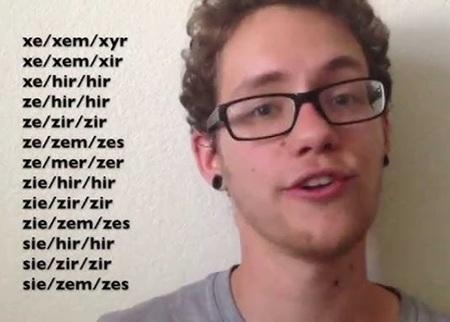
Contrast this to the worldview where we hear words like cisgender, transgender, ze, hir, zie, or xe. In this worldview, gender is not determined by biology, but by what you feel you are. In this worldview, people will speak of gender assigned at birth, based on one’s reproductive system, but this may not be the gender you really are. You will have to decide at some point. In sum, gender is not rooted in your biology but in your will. If your will and your biology do not line up, some will pursue the drastic measure of gender modification therapy. For those born as females, this may mean mastectomies and removing the uterus. For those born with a male body, this may also mean surgery to remove certain body parts as well as hormone therapy.
How has this come about?←⤒🔗
If one looks over the last fifty years of history, it is evident that there has been a radical change in talking and thinking about gender. A word like cisgender, for example, began to appear only in the 1990s. How has this change come about?
It is not difficult to see a connection between the rise of these views on gender and the receding of the place of the Christian faith in society. A brief surge in church attendance after the Second World War began to decline in the 1960s. As the decades passed, Christian values have increasingly been marginalized, even demonized. As people who used to be in the closet with respect to sexual views and practices came out of the closet, God was stuck in the closet. When God’s put away, people go astray.
The root, however, can be traced back further. It lies in the fall into sin. There man’s nature became totally corrupt. Every aspect of humanity, including our sexuality, has been affected by that fall. Sexual issues have always been laying latent in the sinful human heart. It was evident in Lamech, who took two wives. It was evident in the conduct of the people in Sodom and Gomorrah and the Canaanites. It was evident in the days of Paul, as we can see in the opening chapter of the letter to the Romans, and his repeated instruction in proper sexual conduct in various letters (e.g., 1 Cor 5 & 6; Eph 5; 1 Thess 4).
It is evident not only in sexual conduct but also in sexual confusion, or, as is it is called, gender dysphoria. As the fall into sin has affected every aspect of human nature, it is not surprising that it shows up in sexual feelings which do not line up with one’s biological gender. We do well to remember that every sin and sinful inclination can appear in the lives of God’s people as well, for it is simply the old nature trying to reassert itself. The devil continues to sing his seductive siren song, with the subtle refrain, “Did God actually say...?”
The gospel response←⤒🔗
Amid this sexual confusion, we should remember the gospel of redemption. Redemption means forgiveness of sins, including sexual sins. It is also restoration to a lost condition. As is evident in our Lord forgiving of the woman caught in adultery (John 8:1-11), as well as the presence in the Christian congregations of those who had formerly lived sexually immoral lives (1 Cor 6:9-11), the cross covers all sexual sins. God’s grace, however, is not that we may sin even more, but that we begin to walk in the way of the Holy Spirit. There is a distinct biblical sexual ethic, which includes a distinct understanding that one’s gender is obvious from the day one is born.

The awareness of the effect of the fall into sin on our whole nature, including our sexuality, should make us compassionate with those who struggle with sexual issues. We do well to keep in mind that it is not only those who struggle with gender issues who show the effect of the fall into sin, but also those who are struggling with lustful thoughts or who are drawn to pornography, either while single or married. Being compassionate is not the same as tolerating or accepting conduct that God forbids. Rather, it is realizing the lifelong struggle against sin and the sinful nature.
The gospel will determine how to address those of the world. We can be sympathetic to their plight, seeing how they are under the dominion of Satan. At the same time, we may hold before them the gospel as it exposes sin and holds out hope for all sinners. This may come across as harsh and cruel, but it is an expression of love, for the gospel is the only true balm for the soul unto eternal life.
Language of God’s love←⤒🔗
In this world, the gospel will sound like a foreign language, even a dead language, as it speaks of sin, a Saviour, and calls for a life of service. There will be pressure to bring the gospel language in harmony with the language of the world. It will not be possible though, for here is a contrast of the languages of two kingdoms, namely, the kingdom of God in contrast to the kingdom of darkness. It is not the language of the kingdom of God that is a dead language. Rather, it is the language of God’s love, the language of eternal life. The language of the kingdom of darkness promises life, but it brings eternal death. The gospel has conquered hearts in the past. It is still doing so. It will continue to do so, not by toning it down or trying to make it in harmony with the language of the world, but by simply speaking it faithfully. It may come across as folly to those who are perishing, but it is the power of God unto salvation.
Glossary←⤒🔗
It is not difficult to find a glossary of these examples of unfamiliar terms. The following is a sampling taken from the City of Toronto’s “Guidelines for Accommodating Gender Identity and Gender Expression.”
Cisgender: Cisgender is used to explain the phenomena where a person’s gender identity is in line with or “matches” the sex they were assigned at birth. Cis can also be used as a prefix to an assortment of words to refer to the alignment of gender identity and the assigned at birth sex status including: cisnormativity, cissexual, cisgender, cis male, cis female.
Gender: Gender is based on the expectations and stereotypes about behaviours, actions, and roles linked to being a “man” or “woman” within a particular culture or society. The social norms related to gender can vary depending on the culture and can change over time.
Genderqueer/Gender non-conforming/Gender variant: Individuals who do not follow gender stereotypes based on the sex they were assigned at birth. They may identify and express themselves as “feminine men” or “masculine women” or as androgynous, outside of the categories “boy/man” and “girl/woman.” People who are gender non-conforming may or may not identify as trans.
Gender spectrum: The representation of gender as a continuum, as opposed to a binary concept.
Intersex: A term used to describe a person born with reproductive systems, chromosomes, and/or hormones that are not easily characterized as male or female. This might include a woman with XY chromosomes or a man with ovaries instead of testes. Intersex characteristics occur in one out of every 1,500 births. Typically, intersex people are assigned one sex, male or female, at birth. Some intersex people identify with their assigned sex, while others do not, and some choose to identify as intersex. Intersex people may or may not identity as trans or transgender.
Sex: Sex is the classification of people as male, female, or intersex. Sex is usually assigned at birth and is based on an assessment of a person’s reproductive systems, hormones, chromosomes, and other physical characteristics.
Sexual orientation: Sexual orientation is the direction of one’s sexual interest or attraction. It is a personal characteristic that forms part of who you are. It covers the range of human sexuality from lesbian and gay, to bisexual and straight.
Trans/Transgender: Trans/Transgender is an umbrella term that describes people with diverse gender identities and gender expressions that do not conform to stereotypical ideas about what it means to be a girl/woman or boy/man in society. “Trans” can mean transcending beyond, existing between, or crossing over the gender spectrum. It includes but is not limited to people who identify as transgender, transsexual, cross-dressers, or gender non-conforming (gender variant or gender-queer).
Trans identities include people whose gender identity is different from the gender associated with their birth-assigned sex. Trans people may or may not undergo medically supportive treatments, such as hormone therapy and a range of surgical procedures, to align their bodies with their internally felt gender identity.
Transition: Transition refers to a host of activities that some trans people may pursue to affirm their gender identity. This may include changes to their name, sex designation, dress, the use of specific pronouns, and possibly medically supportive treatments such as hormone therapy, sex-reassignment surgery, or other procedures. There is no checklist or average time for a transition process, and no universal goal or endpoint. Each person will decide what meets their needs. Two-spirit: Two-spirit is a term used by Indigenous people to describe from a cultural perspective people who are gay, lesbian, bisexual, trans, or intersex. It is used to capture a concept that exists in many different Indigenous cultures and languages. For some, the term two-spirit describes a societal and spiritual role that certain people played within traditional societies; they were often mediators, keepers of certain ceremonies; they transcended accepted roles of men and women and filled a role as an established middle gender.
Add new comment