
Standing on the Shoulders of Giants
Standing on the Shoulders of Giants
Nothing that is worth doing can be achieved in lifetime; therefore we must be saved by hope. Nothing, which is true or beautiful or good, makes complete sense in the immediate context of history; therefore we need to be saved by faith. Nothing we do, however virtuous, can be accomplished alone; therefore we must be saved by love.
Reinhold Niebuhr

It is the modern way to rewrite the past, avert our eyes from the future and limit our view to the self, the here and the now. This trait has produced a generation which is ignorant and therefore ungrateful of those giants on whose shoulders we now stand, arrogant in believing this to be the supreme age, the end of history, and selfish in seeing ourselves as consumers of opportunity and wealth rather than their stewards as we seek to hand the world on in better shape than we found it.
As I walked past Embankment in London last week I came across a statue to a remarkable man whose life and example are a much-needed antidote to the modern way, his name — William Tyndale the Bible translator.
Tyndale was born in 1494 Gloucestershire, England into a period of seismic shifts in the social and spiritual tectonic plates of Europe and the known world. The fall of Constantinople to the Ottoman Turks and the flight of Greek scholars to western Europe; William Caxton set up the first printing press in England; Columbus discovered America; The Inquisitor General of Spain would have burned to death 8,800 accused of heresy and tortured and imprisoned 90,000 more, and a young theology professor by the name of Martin Luther nailed his Ninety-Five theses against the Catholic Church to the door of the castle church at Wittenberg.
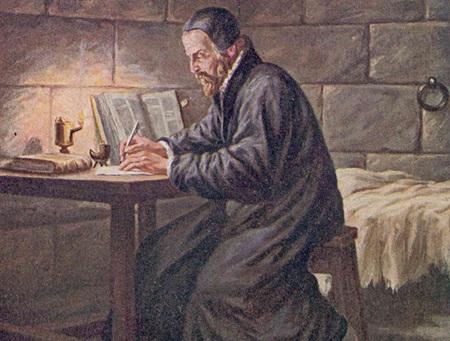
In considering the life of William Tyndale it is possible to discern at least seven characteristics, which are the hallmark of all spiritual leaders:
-
Vision. is common to all great leaders. It is the ability to rise up above the immediate struggles of a given time and place and to point the way to a better land. Robert Kennedy said “Some men see things as they are and say why. I dream things that never were and say why not.” The Bible instruct us, “Where there is no vision the people will perish” (Pro 29:18).
Tyndale was first and foremost a visionary. Whilst at Magdalen Hall (now Hertford College), Oxford he was embroiled in an argument with a group of scholars, when one of them said that they would be better off without God’s law than the pope’s. Tyndale responded with indignation, “I defy the Pope and all his laws, and if God spare my life I will cause the boy that driveth the plough to know more of scripture than thou dost.”
It was this pledge, which became the vision around which Tyndale’s future life would be shaped. He would not live to see the vision fulfilled, but because his eyes were fixed on eternity he was not discouraged by time.
-
Preparation. Visions remain but dreams without implementation. The essential precursor of implementation is preparation. This is the example, which Jesus showed us when, after His baptism and before He embarked upon His ministry, He went into the Desert of Judea for forty days of prayer and fasting. The children of Israel wandered the deserts for forty years until they were ready to enter the Promised Land. William Tyndale had his vision and now began to prepare, first by studying the three great languages of antiquity — Greek, Hebrew and Latin, which would be essential in order to fulfil his vision of translating the Bible into English and later he would add French, German, Spanish and Italian becoming fluent in all.
He then went on to study the skill of translation under Martin Luther at Wittenberg University home to the finest libraries of Biblical texts in Europe, where translations of the New Testament and Pentateuch had already been translated into German. Eagerness and a willingness to learn from others are essential to preparation for any great endeavour. A disdain for the wisdom and experience of those who have gone before is a sure way to failure.
-
Perseverance. Seldom does anything worthwhile come at the first attempt and without struggle and hardship. James wrote, “Consider it pure joy when you face trails of many kinds, because you know that the testing of your faith develops perseverance. Perseverance must finish its work so that you may be mature and complete, not lacking anything.” (1:2-4).
The bishops’ Convocation at Oxford in 1408 had forbade the translation and certainly the possession of an English version of the Bible. At the time of Tyndale’s work of translation Henry VIII was still loyal to Rome in matters of religion and had no hesitation in upholding the ban on translation into the vernacular and supporting Cardinal Wolsey’s brutal repression of those who transgressed. William Tyndale and his fellow translators and printers were harried through Germany and into Belgium, sometimes escaping the King’s agents by minutes and needing to start all over again in a new town.
Once the New Testaments were completed they then had to be smuggled into England and distributed. There was even a ban placed on all Flemish and German vessels from entering English ports in an attempt to stem the flow of Bibles into England. Such was the ferocity of this purge against Tyndale’s translation that only one complete copy remains today.
-
Courage. It is humbling for anyone who has sought to conceal a Bible on the way to or from church, or, been reticent about reading the Bible in public places, to remember the courage, which was evident in those who first brought us the Holy Scripture in our mother tongue. It was a matter of life and death. Many of Tyndale’s friends, most notably John Fryth, were martyred or subjected to torture in order to reveal information about Tyndale’s whereabouts. He was frequently betrayed but remained without bitterness.
Tyndale was calmed by the justice of his cause and confidence in its ultimate success calmed him. Courage, said Hemingway, is ‘Grace under pressure’ Tyndale had pressure and God poured out the Grace.
-
Teaching. It is in our nature to carry with any great work delusions our indispensability and immortality. If a work is truly of God then it will necessarily transcend the capacity of any one individual to bring it to fruition. The mark of a truly great leader is one who invests their knowledge and time in others so that the work begun may continue to completion after they are gone. Jesus called the disciples and taught them being patient and forgiving with their fickleness and mistakes.
William Tyndale was a wise leader in that he spent a significant amount of time sharing his knowledge of translation; two of these men were Miles Coverdale who would prepare the first licensed version of the Bible in English in 1537 and John Rogers, who would later be martyred, completed the remaining books of the Old Testament from Tyndale’s translation and these too were published as ‘Matthew’s Bible’ in 1537 again under licence.
-
Service. A man of Tyndale’s education would have been much in demand. The printers and publishers of the sixteenth century were the software billionaires of their generation; such was the demand for the new technology of the printed word. If Tyndale had devoted his skills as a translator to the great classical works of Athens and Rome then he would have had been assured of a very comfortable life. But, instead, Tyndale devoted his life to the service of the ploughman and the maid that they may have access to the inspired Word of God in their native tongue. It was a life of sacrifice and service in the Spirit of Jesus.
Three centuries later the social historian Trevelyan would write of another servant of humanity, William Wilberforce, ‘He (Wilberforce) could not have done what he did if he had desired office. With his talents and position he would probably been Pitt’s successor as Prime Minister if he had preferred party to mankind. His sacrifice of one kind of fame and power gave him another and a nobler title to remembrance.’
-
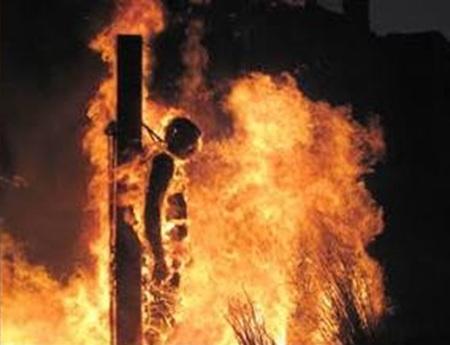
Prayer. Eventually the authorities caught up with William Tyndale after he was again betrayed by a friend, this time — Henry Phillips. Tyndale was taken to the Castle of Vilvoorde where after sixteen months of incarceration he stood trial and found guilty of heresy. On October 6, 1536 Tyndale was brought to the town square of Vilvoorde (six miles north-east of Brussels) to be strangled and then his body burnt.
When given a final opportunity to recant he instead offered up a final prayer, “Lord, open the King of England’s eyes.” Less than one year later the King Henry VIII of England would issue the following injunction to be implemented in every parish in England: “That ye shall provide, on this side of the feast of All Saints next coming, one book of the whole Bible of the largest volume in English, and the same set up in some convenient place within the said church that ye have cure of, whereas your parishioners may most commodiously resort to the same and read it.” In case we were tempted to forget — prayer changes things.
 ⤒🔗
⤒🔗
Questions:←⤒🔗
- What is my vision? What is God’s vision? How do these two visions compare? Where do they overlap and where do they diverge?
- Who inspires me and why? In what ways do their lives embody the characteristics of spiritual leadership? What can we learn from their example?
- In what ways are our lives a blessing to others? How are we investing in the next generation? How is my time contributing to eternity?
Add new comment