
The Road to the AV: A Survey of the New Testament From the Apostle Paul to Miles Smith
The Road to the AV: A Survey of the New Testament From the Apostle Paul to Miles Smith
 ⤒🔗
⤒🔗
From Manuscript to Print With mine own hand←⤒🔗
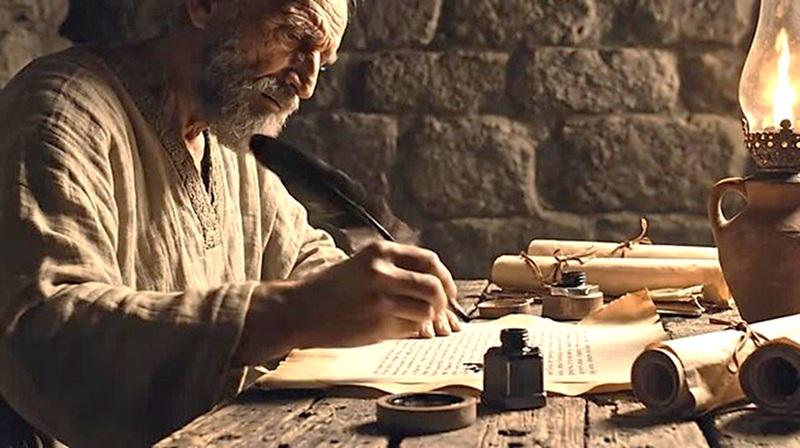
Paul's letter to the Galatians is probably one of the earlier pieces of New Testament writing. In chapter 6 verse 11 he declares 'Ye see how large a letter I have written unto you with mine own hand'.1 This reminds us of a basic fact to do with the unfolding history of the New Testament, a point so obvious that we easily forget it. For three-quarters of the time that the New Testament has existed it has only done so in copies made by hand, truly 'manu-scripts', two Latin words meaning hand-written.2
Palestine in Apostolic times was under Roman rule, but for about three hundred years before that it had been under the cultural dominion of Greece. Greek was the everyday language throughout the whole Mediterranean region, acceptable even in Rome. This was the language of `the fulness of the times', and was the instrument used, under the Sovereign Spirit of God, for that written record which is the New Testament of our Lord and Saviour Jesus Christ. Very quickly the burden of copying and translating these Scriptures was taken up by the churches. The practicalities of accurately multiplying and disseminating the written Word of God start us on the path to the present printed editions of our English Authorised Version.
Rolls and Papyrus←⤒🔗
In New Testament times the Greeks and Romans used papyrus rolls for writing. Papyrus is the fibrous pith of a water plant once plentiful in the Nile, but scarcely found there now. Two layers of fibres laid at right angles to each other, soaked, squeezed and glued, formed sheets of a material that could receive marks. The side with horizontal fibres was intended for writing (the 'Recto') but it was quite possible to use the reverse (the 'Verso'). Best quality sheets were those using the largest fibres, and such sheets were joined side-by-side to make rolls of any length. The longest roll known is 133 feet (40.5m), but the average length of Greek literary rolls was 35 feet (10m). Height was variable, the usual being 10 inches (254mm) although 19 inches (482mm) was not unknown, and there were 'pocket' scrolls of only 5 inches (127mm). On such papyrus rolls the writing was most often in columns 21/2-3 inches (63.5-76mm) wide. There were margins between columns and at the top and bottom for annotations and the insertion of corrections, etc. Ordinarily, rolls were written only on one side but if material was scarce or there was a lot to be said, they could be written 'within and without' (Ezekiel 2.10) or 'within and on the backside' (Revelation 5.1).
Sometimes the verso of an existing work was used for more writing — one early 4th century manuscript of Hebrews (P13) is on the back of a 3rd-century condensed edition of the Epitome of Livy.
Taking average figures as a guide, we can visualize the autographs of the New Testament books (that is, the first written forms made by John, Luke, etc.) being written in this manner. An epistle such as 2 Thessalonians would be contained on a 15-inch roll of five columns only. Romans would need 111/2 feet, Revelation 15 feet, Mark 19 feet, Luke 32 feet! So long as the papyrus roll was the medium of literature, the various copies of the books of the New Testament almost certainly circulated separately. Each book has its own 'history'. Indeed, until the use of the printing press in the 15th century very few Christian communities, and even fewer individuals, possessed all the canonical books.
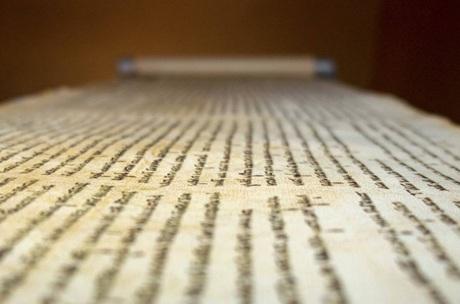
Imagine the difficulties of using scrolls. I can quote Revelation 5.1 and expect you easily to verify this reference in a Bible — but what if you had a collection of scrolls to sort out, and no pages to turn or verse and chapter numbers! Remember, there are no `reader aids' or 'editorial input' — Noseparationofwordspunctuationminimallatercorrectionsattopandbottomscarcelyanycapitaisorparagraphsandnochapterorversenumbersandthelinesdontalwaysrunthesameway. How difficult to find the exact verse — perhaps we should excuse those early Christian writers who quote 'freely' and sometimes quote the same verse slightly differently, or just say 'somewhere in Luke'.
Codices and Vellum←⤒🔗
Christians were particularly concerned to improve on this. As early as the 2nd century AD 'codex' experiments were tried. A papyrus codex is made up of sheets of papyrus folded once into a 'quire' or gathering, like a gigantic scrap-book. It is in fact the basis of the book as we have it today, and it was the desire of the churches for 'user friendly' and portable Scriptures that helped establish this now universal system of book construction. Truly, in the providence of our mighty God the full record of His Word deserves even in this small but significant point to be called The Book. Quires were fastened by threads through the inner margin, like a modern stapling process, and sometimes monstrous fifty-sheet folds were used in a single cumbersome quire. One famous papyrus codex referred to in the cataloguing system for these documents as P46, called Chester Beatty II, was once a single quire codex of 104 leaves — only 86 are known to exist now.
A more usual format was quires of 8-12 leaves, joined as needful. The main advantage of this was that more material could be contained, and more easily consulted, without the volume becoming unmanageable. P46, referred to above, originally contained all the Pauline epistles except Timothy and Titus. As a scroll this would have needed one of 60 feet — or at least two 30-footers. The five separate scrolls needed for the Gospels and Acts are replaced in the 3rd century by one codex, P45 (Chester Beatty I).
Another step in the external form of New Testament material came with the establishment of Christianity under the reign of Emperor Constantine, in the 4th century. The status of the Christian documents changed abruptly, and the wholesale destruction of books that had accompanied earlier persecutions ceased (for a while). Demand began to grow instead throughout the empire as Christianity became respectable. Just at this point the book makers reintroduced vellum as the writing material. It had been in use for some time in Pergamum from about 190 BC, but never on a large scale (and it is a form of the name of that town which gives us the name 'parchment' for vellum).
Vellum is made from the skins of cattle, sheep and goats, especially young ones. The hair is scraped off, the skins washed, rubbed with pumice, and dressed with chalk, giving an almost white sheet, durable and easy to write on in black or certain other colours. Once Christianity became an imperial religion, the physical appearance of the books took on an importance that had not been there before, and some of the vellum codices of Scripture are extremely beautiful things to look at, though not necessarily reliable or accurate because of that! For completeness I note that 'paper', a Chinese cloth-based refinement of the papyrus writing material, did appear in the West in the 12th century, but from the 4th-15th centuries vellum was the preferred material.
Translations←⤒🔗
Scripture, existing in three languages, and offering translations within itself, (Matthew 1:23; Mark 5:41, 15:22, 34; John 1:38, 41, 42, 9:7; Acts 4:36, 9:36, 13:8) is inherently translatable, and response to the need for Scriptures in the vernacular, or common language of a people, is as old as the New Testament. Early translations of the New Testament from Greek into Latin began about 180 AD, and both Old and New Testaments were in fact translated from Greek (the Old Testament from the Septuagint). The early translation of the Old and New Testaments into Latin is referred to as the 'Old Latin'. Around 300 AD there was a translation of the New Testament into Syriac, the 'Old Syriac', and also four Coptic Versions, the language spoken in four dialects in Egypt. Other early translations of the Scriptures were in Armenian, Georgian, Ethiopic, Slavic, and Gothic.
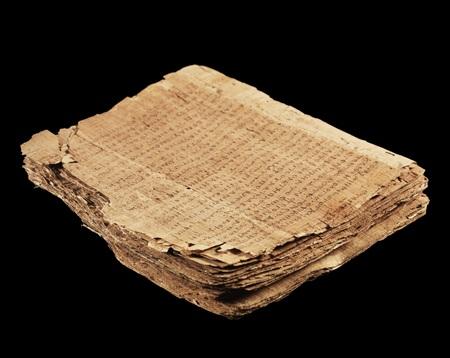
The most significant and influential translation was in 380 AD, when Jerome translated anew into Latin the Old Testament from Hebrew and the New Testament from Greek. This return to Hebrew rather than Greek as the proper source for Old Testament translation, although beyond doubt the correct procedure, was strongly resisted and resented at the time. However, this Latin version, styled the 'Vulgate' because it was the vulgar, or common, language, became the Bible of the Western Church until the Protestant Reformation in the 1500s. Apart from the long, slow adulteration of the Vulgate text over 1000 years,3 it generated problems of translation all through that time. From Augustine to Erasmus, Bible translation never escaped the incubus of Latin as the source text. This historical period, in very general terms, is that of the Byzantine Empire, centred in Byzantium (subsequently Constantinople, now Istanbul). Most Greek scholarship and literature, including many Biblical texts, were drawn there, and thus for a time lost to the Western world.
English Scriptures: Caedmon to Wycliffe←⤒🔗
There were yearnings and strivings toward the provision of English-language Scripture all through the so-called Dark Ages, as the following brief list indicates:
440 … Roman legions withdraw from Britain.
670 … Caedmon composes poems in Old English derived from the Biblical narratives.
825 … Vespasian Psalter — interlinear Old English translation of the earlier Latin text.
900 … Paris Psalter — Old English version of the first fifty Psalms.
950 … Aldred writes Old English between the lines of the Lindisfarne Gospels.4
970 … First Old English version of the Gospel of Matthew, based upon Aldred's gloss.
The Rushworth Gospels.
1000 … Aelfric translates abridged Pentateuch and several other portions of Scripture into Old English.
The 'Wessex Gospels' and first Old English version of all four Gospels.
1200 … Orm's poetical paraphrase of Gospels and Acts in Middle English.
1300 … Midland Psalter — metrical version of the Psalms in Middle English.
1320 … Richard Rolle's Middle English Psalter.
1382 … Wycliffe completes translation of the Bible.
1388 … Wycliffe Bible corrected by John Purvey.
The chronicler William of Malmesbury, 1090-1143, assures us that King Alfred, 849-899, had memorised the New Testament and Psalms together with other Old Testament portions, and was engaged at the time of his death in a new translation of the Psalms. You must realise that the language used was quite variable throughout the 'Kingdoms' in Britain. An 'English' document produced in Wessex would not necessarily be useful in Mercia or Strathclyde or Northumbria, and we would not find any of these older forms easy to the eye, ear or tongue now! Compare these renderings of Luke 2:7, 11:
[11th century: Wessex] and heo cende hyre frumcennedan sunu. and hine mid cildclaPum bewand. and hine on binne alede. forPam Pe hig naedon rum on cumena huse ...forPam todaeg eow ys haelend acenned. se is drihten crist on dauides ceastre;
[14th century: Wycliffe] & she childide hir first goten sone, & wlappede hym in doPis & putte hym in a cracche, for Per was not place to hym in Pe comun stable...for a saueour is born to day to vs, Pat is crist a lord in Pe cite of dauid and for contrast:-
[16th century: Tyndale] And she brought forth her first begotten sonne and wrapped him in swadlynge cloothes and layed him in a manger because ther was no roume for them within in the ynne...for veto you is borne this daye in the cite of David a saveoure which is Christ ye lorde.
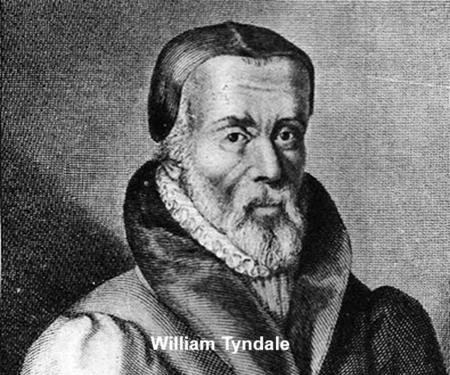
Tyndale may strike us as quaint, but is quite comprehensible — one can read it aloud and hearers would understand; but without some familiarity with the sounds and orthography of Anglo-Saxon English it is none too easy to read Wessex or Wycliffe. Nevertheless, it is good to know that even around 1200 AD Orm had brought John 3:16 to the English of his day:
Thurrh thatt to Laferrd seggde thus
In that the Lord said thus
Till Nicodem withth worde
To Nicodemus with word
Swa lufede the Laferrd Godd
So loved the Lord God
The Werelld tatt he sennde
The world that he sent
His aghenn sune Allmahtig Godd
His own son Almighty God
To wurrthen mann on erthe
To become man on earth
To lesenn mannkinn thurrh hiss death
To release mankind through his death
Ut off the defless walde
Out of the devil's power
Than whase trowwenn shall on himm
That whosoever shall believe on him
Wel mughe wurrthenn borrghen5
Surely may become saved.
The greater problem however for the accuracy and authenticity of all these English manuscript versions was their textual provenance. These were all derived from the Latin Vulgate, not the Biblical language texts. Not only was the starting point wrong — a translation of a translation — but the corruptions in and variations between copies of the Vulgate were growing out of hand in the passage of time.6 There was at this point in the history of the text of Scripture great need for a method of reproduction which would anchor the text in a stable and accurately repeatable form, and for a return to the awareness and use of the Biblical languages as the only authoritative basis for translation.7
Amongst those who used the Latin Bible and the Old English portions derived from it, there was some understanding of the problem of 'second-hand' translation. Savour this 11th century poetic Welsh rebuke of those who translated the Psalms from Greek:
This harp the holy Hebrew text doth tender
Which, to their power, whilst everyone doth render,
In Latin tongue with many variations
He clouds the Hebrew rays with his translations.
Thus liquors when twice shifted out and poured
In a third vessel are both cooled and soured;
But holy Jerome truth to light did bring
Briefer and fuller, fetched from the Hebrew spring.8
 ←⤒🔗
←⤒🔗
Printing←⤒🔗
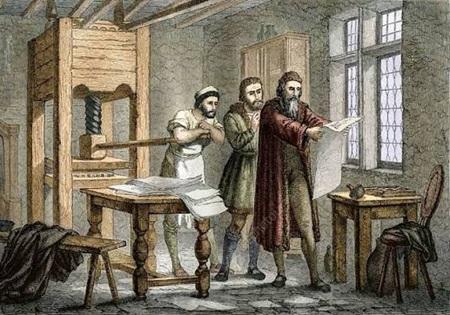
To contemplate the unfolding of history as in very truth the Living God dealing with His people and His Word in the midst of a careless and indifferent world, is a joyful source of refreshment and ground of praise for the believer. This is particularly true of the amazing confluence of events affecting the history of the Bible text in the 15th and 16th centuries. To meet the need just outlined we see that in Europe conditions were just ready for the large scale production of texts. The requirements for book-printing were available: paper was being produced and used in Europe,9 artists had invented an oil-based ink which could be adapted for printing on paper and vellum, instead of insubstantial watery ink. There were presses in use for printing designs on textiles, adaptable for paper printing, and workers were already making metal plates to use for stamping the covers of manuscript books. The time was ripe for Johann Gutenberg's invention of printing with moveable type. Such was the impact of printing, and its use for the Bible and religious material generally, that a contemporary verse expressed his admiration of Gutenberg, born in Mainz around 1397, was trained as a goldsmith. He set up a foundry with press in Mainz, and experimented with the concept of printing with moveable metal type. Finally, around 1453, he printed the editio princeps10 of the Latin Bible. Unfortunately for him, he was heavily in debt and in 1455 his creditor and partner, Johannes Fust, closed on the loans. Gutenberg did finish printing the Bible, but lost his press equipment and metal fonts to Fust. After this he seems to have wandered to other cities, teaching the new technique of printing, and died in his native town in 1468.
The Englishman William Caxton (1422-91) acquired the technique of letterpress printing when he was in Cologne in 1471-2. In association with the Flemish calligrapher Colard Mansion, Caxton set up a press in Bruges, printing the first books in English there. Then, in 1476, he set up the press in Westminster and printed the first book in England11 in 1477. Caxton was very cautious about the political consequences of any attempt to print an English Bible, Lollardy and the Wycliffe Bible being seriously proscribed. However, in his first edition of Jacobus de Voragine's The Golden Legend, 1483, he embedded large portions of Scripture material (the greater part of the Old Testament, in fact) which he had translated into English from the Latin and French sources of Voragine.
Book printing is now in place, and Bible production in multiple copies of the same text is possible. One more piece is needful to put the English Bible on track — the break with the Latin text as the basis of translation.
The Fall of Constantinople, and the Greek New Testament←⤒🔗
The year 1453 marked not only the first printing of the Bible, but also the overthrow of the city of Constantinople. This city on the northern shore of the Bosphorus had been called Byzantium, and today is Istanbul. For a thousand years, Byzantium had maintained an Empire, derived from the Roman Empire, nominally Christian and wholly Greek in language, literature and culture. The burgeoning strength of the Ottoman Muslim Empire under Mehmat II, centred in Anatolia (modern Turkey), laid siege to the waning culture of Byzantium. In fifty-four days the city fell. So huge were the effects of this event that some historians have used it as marking the beginning of 'Modern' history.12
For the history of the text of Scripture the significance is that Greek scholars, scholarship and literature surged westward seeking refuge. On the European stage, the scene was set for the flowering of the Renaissance; for the Western Churches the original language texts of the New Testament were brought again to mind, with men capable of instructing others in them.13 Many of these displaced scholars went to Italy: that is, from New Rome (Constantinople) to Old Rome. The first part of the Bible to be printed in Greek was a Greek and Latin Psalter of 1481 in Milan, but work on the printed New Testament was soon in hand.
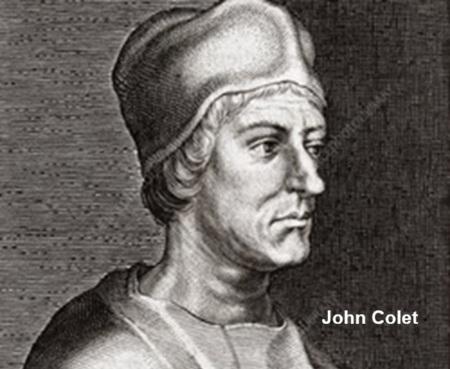
John Colet, 1467-1519, will serve us well to illustrate events of those times. He was the eldest son of the Lord Mayor of London, Sir Henry Colet, and was educated at St Anthony's school and Magdalen College, Oxford, earning an MA in 1490. In 1493 he went to Paris and then to Italy, where he was able to study the rudiments of Greek14 sufficiently well later to assist Thomas Linacre in the production of the first printed Greek grammar in England. This journey to France and Italy, seeking the New Learning, and return to London, Oxford and Cambridge to spread it, was a familiar path at that time. During his years abroad, John Colet became acquainted with the teaching of Savonarola, and with Erasmus whom he strongly influenced and drew to England.
Colet's most significant contribution to the English Reformation was his reading the Greek New Testament with his students at Oxford, a momentous lecture series on Romans which 'swept away centuries of turgid and often fantastic pedantry' by expounding the text in accordance with the plain meaning of the words. Such activity was strictly forbidden by the church, but subsequently Colet went even further, reading the Scriptures, in English, in public, at Saint Paul's Cathedral.15 In this open violation of the church's 'Latin-only' policy Colet demonstrated the hunger for the Gospel in English, tremendously fueling the growing fire of the Reformation.
Now we have the appointed conjunction of the printed book, the renewal of Greek learning, the availability of Greek New Testament manuscripts, and the Christian scholars' need to translate anew from a clear ground-text. Furthermore, the appetite for Scripture in the common tongues of Europe was growing wherever opportunity allowed. Erasmus of Rotterdam and Ximenes of Complutum (Spain) were working towards the printed texts16 of the New Testament in the dawning years of the 16th century.
Ximenes completed his Polyglot a year before Erasmus printed his Greek, but did not publish, so that the first printed Greek New Testament actually published was that of Erasmus in 1516. None of these three men, Colet, Erasmus, or Ximenes, ever made the needful break with Rome, and yet in the sovereign providence of God they gave provision to complete the Reformation task — paper, print, and the Greek New Testament. The English Reformers fell gladly on this provision, the better to learn of Christ and the Truth as it is in Jesus, and to preach the Gospel plainly, becoming mighty through God to the pulling down of strongholds. And, that the Gospel might not perish with them, they used this Greek New Testament to be the sound basis of the New Testament in English, translated and printed for the use of preachers, ploughboys and kings.
Tyndale to Hampton Court←⤒🔗
At the risk of oversimplifying, I would suggest just five steps in one hundred years: (1) the printed Greek New Testaments, 1516E; (2) the Tyndale/Coverdale Bibles17 1525ff; (3) the Geneva Bible (with Coverdale in the picture still), 1560; (4) the Bishops' Bible, 1568; (5) the Authorised Version of 1611. It is not the purpose of this article to examine anew these historic versions. Tyndale and Coverdale are well known in their labours (see QR 528 for Tyndale, and QR 567 for Coverdale).
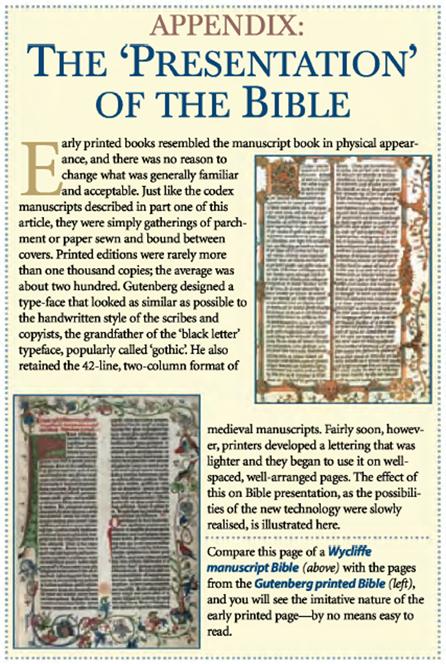
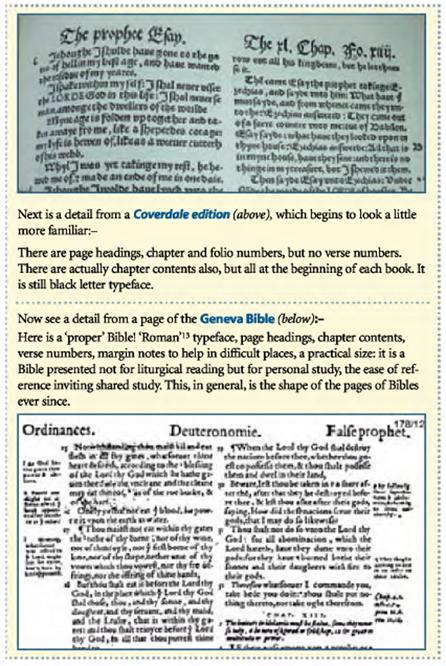
The Geneva Bible should be noted, in our context, as being a Bible produced by exiles from Mary's persecution under almost 'specimen' conditions, removed from the immediate fear of hostile force, by men of great experience combined with time for the task. Its robust presentation of Truth, in both text and notes, earned the approval of the 'stronger kind of Protestants' and the disapproval of most religious authorities.(The significant appearance of the printed page of the Geneva will be taken up in an appendix.)
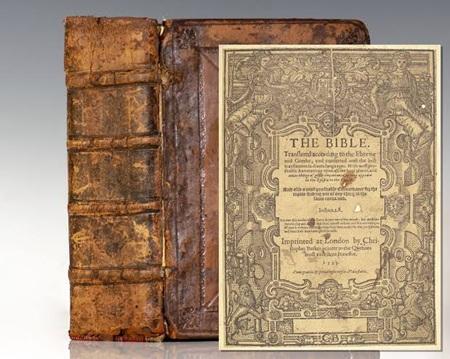
You may be surprised to see the Bishops' Bible included in these steps — but in the wisdom of God, it became a crucial part of the Road to the AV. The Geneva Bible and its swift acceptance amongst English Protestants was highly disturbing to the ecclesiastical authorities.18 Archbishop Parker put in hand a revision of the Great Bible, to be done by eight Bishops and certain other scholars. Poor communication or lack of cooperation amongst the team led to a very uneven result, despite Parker's supposed general oversight. The Bishops' Bible, although appointed to be read in churches, did not displace the Geneva Bible from homes or studies, or even from some pulpits. Two years after its last printing in 1602, the insufficiency of the Bishops' Bible was a huge factor in the acceptance by King James of the need for a new translation at the Hampton Court Conference of 1604. (Please see QR 566, 'Kings and Puritans, Bishops and Bibles', for this background, and for the conclusion of it in the Authorised Version of 1611.) Sovereign providences had brought together the Greek Text, the English language, and the technology of paper and print, and had brought to the kingdom for just this hour men of urgent calling and ability in the way of Bible translation. The labours of William Tyndale and Miles Coverdale had put in place the last part of the Road to the AV.
'Mere English': Miles Smith←⤒🔗
This phrase, 'mere English’, was dear to Elizabeth I, using the word 'mere' in its primary, though now rare, meaning of 'pure, unmixed, exactly right.' She meant it of her loyal people, her triumphant sailors, her accommodating church; but in contemplating Bible translation labourers from Tyndale and Coverdale to Hampton Court, the phrase comes much to mind in connection with the English Bible. They pursued a 'mere English' New Testament that was just right, pure, simple; in textual authority — the Greek New Testament; in profusion and yet stability of copy — printed; and in accessibility — the common English tongue, not the religious-authority tongue of Latin, nor the elite-authority tongue of French.
The names and the distribution of tasks amongst the 1604-11 Translation Committee are reasonably well known,19 but the overall finishing work of Miles Smith is often lost from view. Miles Smith was born in Hereford, son of a butcher, and educated at Oxford; he graduated with BA in 1573, MA in 1576, BD in 1585 and DD in 1594. Wanting 'nothing but books', and of widely acknowledged humble demeanour, he nonetheless became chaplain of Christ Church, vicar of Bosbury, prebendary of Hereford Cathedral and of Exeter Cathedral, then rector of Hartlebury. Dr. Smith earned a widespread reputation for his knowledge of ancient languages. Chaldaic, Syriac and Arabic were reportedly as familiar to him as his own native tongue. In that age of blossoming in the study of ancient languages, he probably engaged directly with the Scriptures in Hebrew and Greek, and only in English as need arose. His 1632 biographer gives the following story of an event at Evensong one day in Hereford Cathedral:
Being requested by the dean of the same church to read the first lesson, he yielded thereunto, and having with him a little Hebrew Bible, he delivered the chapter from it in the English tongue plainly and fully to that learned and judicious auditory.20
It is no surprise then that he was named to join the Translators, and not only that, but he was one of two required at the end to supply the editor's role and examine the whole work for consistency and integrity — the task which Parker had signally failed to accomplish for the Bishops' Bible. We have it again from the 1632 biography:
He began with the first, and was the last man of the translators in the work for after the task of translation was finished by the whole number set apart for that business, being some few above forty, it was revised by a dozen selected ones of them, and at length referred to the final examination of the learned Bishop of Winchester and Doctor Smith, who happily concluded that worthy labour.
It is probably from Miles Smith that we have the page and chapter headings of the 1611 editions of the AV.
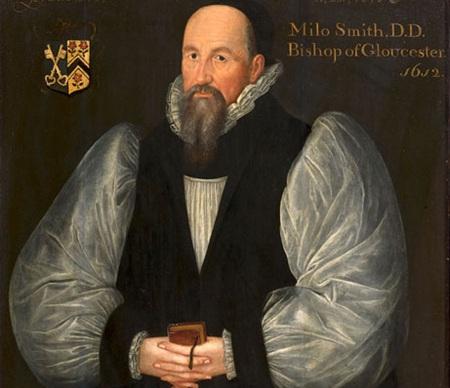
We also learn that Dr. Smith 'was commanded to write a Preface, and so he did in the name of all the translators, being the same that now is extant in our church Bible'.21 This substantial manifesto gives a comprehensive, scholarly and robust review and justification of the task and methods of the translators. It abounds with memorable and relevant material, my own favourite being, 'But now what piety without truth? What truth (what saving truth) without the word of God? What word of God (whereof we may be sure) without the Scripture?'
But the style of the Preface is so different from that of the 1611 Bible that I offer this sample of Miles Smith in the pulpit — and hoping that you will agree with me that this is more the style of our beloved Bible, herein are the echoes of Tyndale, Coverdale and the Geneva Bible:
...Our sins do threaten God's vengeance upon us, our consciences do accuse us, the law containeth matter of indictment against us; all the creatures of God which we have abused, all the calling of God which we have neglected, do witness against us. Hell opens her mouth wide, being ready to swallow us up. The world forsaketh us, our friends have no power to help us. What is to be done in this case? What shift shall we make, what place of refuge shall we fly unto? Only this, that the son of God became the son of Man to make us the sons of God; vile he became, to exalt us; poor, to enrich us; a slave, to enfranchise us; dead, to quicken us; miserable, to bless us; lost in the eyes of the world, to save us. Lastly, partaker of our nature, of our infirmity, of our habitation, to advance us to his kingdom and glory, that is, to be unto us according to his name, Emmanuel, God with us. God to enlighten us, God to help us, God to deliver us, God to save us...
As with many of the 1611 translators, preferment followed, and Miles Smith became Bishop of Gloucester in 1612. Four years later there was a new Dean of the Cathedral, William Laud, the rising opponent of Puritans and plain religion. What a difficult working relationship it must have been, but that, as we say, is another story! Miles stood with his convictions, shared generally by the 1611 translators; and another clergyman of Hereford, preaching the funeral sermon in 1624, told how Bishop Miles would 'discourse sweetly of the certainty of salvation, and of perseverance in grace: comfortable truths so much opposed by papists, Arminians, and carnal gospellers'. I think of him, with affection, as carrying the mantle of his namesake, Miles Coverdale, in these last miles on the Road to the AV.
Résumé←⤒🔗
The labours of the 1604 committees, editorially finished by Miles Smith, had given to the English-speaking world a printed, durable translation of the Scriptures, faithfully founded on the original language texts. Full use was made also of almost one hundred years' labour, drawing not only on English but other European languages, too. Certainly in the New Testament more than nine-tenths can be traced directly to Tyndale; the homeliness and vigour, the directness of style, owing so much to the initial wordsmith craftsmanship under God of Tyndale's Anglo-Saxon vocabulary. It is no surprise that of the eight thousand word vocabulary of the Authorised Version, words of Saxon derivation make up the same proportion, nine-tenths. Add to that the inescapable, unconscious seasoning of the stately rhythms of the Latin which was the working scholarly accomplishment of all these men, and the majestic, vibrant, persuading, memorable cadences of the English Authorised Version are gone into all the world.
Whatever popular opinion may now say about the English Authorised Version, there can be no doubt that it towers above all other works as a benchmark of 'mere English' Scripture. It is not in embellished courtly style: read the Dedicatory Epistle to James22 for an easy comparison. It is not in the densely worded and complexly structured Establishment style: read the Translators to the Reader for comparison. It is not in the colloquial style: read a few scenes from Shakespeare for contrast. In this I intend no denigration of the material mentioned, but desire the outstanding quality of the 1611 English language Bible to be recognised as a signal gift of God, able to serve the saints and churches of God from generation to generation without being tied to passing styles, high or low. A slight misquotation from Shakespeare's Julius Caesar serves the AV well: 'Why, man, he doth bestride the narrow world like a colossus and we petty [versions] walk under his huge legs, and peep about to find ourselves dishonourable graves’.23
Remember as you reach down your Authorised Version, that one of the infallible test questions for revealing a 'heretic' in the Middle Ages was whether he or she possessed, or knew, any part of the Bible in their own language! The Waldensians and the Lollards suffered much from this procedure. As late as 1539 Thomas Forret was burned outside Edinburgh Castle.24
Arraigned in court for teaching his congregation the Lord's Prayer and the Commandments in English, he had quoted the words of Paul from 1 Corinthians 14.19 in defence. 'Where finds thou that?' his accuser cried. 'In my books, here in my sleeve, was the answer. The book, a Testament, was snatched from him and triumphantly waved at the court. 'Behold, Sirs, he has the heresy book in his sleeve — Know thou, Heretic, that it is contrary to our acts and express commands, to have a New Testament or Bible in English, which is enough to burn thee for, which they then did.
Truly, the Road to the AV is marked with suffering and death as well as diligent labour and extraordinary gifts — 'other men laboured, and ye are entered into their labours' (John 4.38). Thanks be unto God!
Add new comment