
Does God like me on Facebook?
Does God like me on Facebook?

I do not have a Facebook account. Go ahead and laugh if you want! I'm secure with who I am. I know who my friends are, and my friends know me.
I don't have a Facebook account, nor do I want one, but I don't think the Bible forbids it. (You can take back your "He's either legalistic or really old-fashioned" thoughts.) Probably most of you do have an account, and that's not necessarily bad.
In this edition of The Next Generation, I want to address the positives of Facebook. I do have some concerns, though, and plan on tackling those next time. But is it possible to use Facebook well, for the glory of God?
The Bible tells us to "give thanks in all circumstances" (1 Thessalonians). It also teaches that "nothing is to be rejected if it is received with thanksgiving" (1Timothy 4:4). Of course this does not mean that everything is permissible as long as we say thanks. Being thankful for pornography does not make it right.
A good question to ask when we come to matters of Christian conscience is this: Can I truly thank God for this? Can I thank God for this movie? Can I thank God for this music? Can I thank God for this use of my time? Can I thank God for this friendship? I think you could ask the same thing about Facebook. Is this something I can thank God for? Let's consider how you might be able to answer yes to that question in three ways.
Communicating information
My decision not to have a Facebook account does not make me technophobic. I preach from an iPad and I text from an iPhone. The problem is not technology per se.
The world has been advancing technologically from the beginning. Part of God's image in man is his capacity and creativity for making things. The invention of the wheel was cutting edge for its time, as was the Gutenberg printing press, the telephone, and the automobile. You get the idea.
We live in a Facebook society. According to a survey from the Pew Internet and American Life Project, together with Harvard's Berkman Center, 95 percent of teens use the Internet, and 81 percent of them use social media sites. Of these, Facebook is by far the most used by an estimated 94 percent.
The most convincing argument I have heard for getting an account is the ability it gives to disseminate information with remarkable ease. With the click of a button, I could post an announcement about youth group or let my friends know what time we are meeting for dinner. In this way, Facebook is a great mechanism for communicating information to others, whether in the form of announcements or updates.
My friend was a missionary in Africa for five years, and Facebook served as a free and easy way for him to communicate with his family, friends, and supporting churches. At one point, he was the only American in a French-speaking city of one million people. The days and especially the weekend were lonely. Fellowship was hard to find. Facebook was a blessing for him, a reason to thank God for His gifts to men.
Facebook also serves the purpose of sharing pictures and posting updates, which can be a wonderful blessing for families separated by distance. My spiritual mentor has children and grandchildren living in Arizona, Michigan, and Massachusetts. Facebook helps keep them informed and in some ways closes the geographical gap.
Ministering to others⤒🔗
Another potential benefit of Facebook is the unique platform it provides to encourage and minister to others. Our family recently went through a tragedy. Facebook was a tool that God used to bring encouragement. People from all over the world, when they heard of the events, could communicate with my brother-in-law and sister-in-law and offer them words of hope and comfort from God's Word. The magnitude of prayer and encouragement was multiplied because of Facebook. I know for a fact that they can thank God for it.
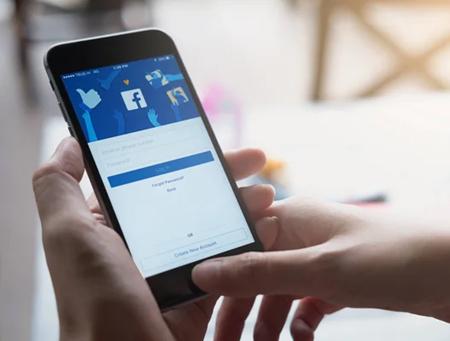
Paul writes to the Thessalonians, "Therefore encourage one another and build one another up, just as you are doing" (Thessalonians 5:11). Social media came long after Paul. He did not have a Twitter account (Would he tweet something like this: "Just saw another conversion to Christ deny yourself"). Christians without Facebook can and must encourage others. But Facebook can serve as a mechanism.
So let me ask you this: Are you using Facebook to build others up? When is the last time you wrote something that encouraged someone else? Words have power. They can build up or destroy. Says James, "Look at the ships also: though they are so large and are driven by strong winds, they are guided by a very small rudder wherever the will of the pilot directs. So also the tongue is a small member, yet it boasts of great things" (3:4-5).
Defending the faith←⤒🔗
The third positive of Facebook I would like to consider is its capacity to defend the faith. If Martin Luther lived in the twenty-first century, would he have posted his Ninety-Five Theses on the Wittenberg door – or on the Internet?
Apparently there is a lot of debating happening in online chat rooms and Internet forums. This can turn ugly fast, but it also provides a unique opportunity for Christians to engage non-Christians with the truth of the gospel.
A mom of six children from our congregation is routinely having Facebook discussions with
atheists, agnostics, and people from different religions. Sometimes she sends me the highlights (or lowlights, depending on context). I am delighted to see her engaged in this sort of activity and doubtful she would have the opportunity to do so without Facebook since all six of her children are under the age of fourteen.
A lot of churches use Facebook as a tool of communication and invitation to attend services and special events. Most people do not use phone books anymore (for those of you too young to remember, a phone book is a book that includes a list of names and phone numbers). Facebook is the new phone book! It makes me wonder if my children's children will even know what Facebook is!
The Great Commission is the church's call to spread the gospel to every nation. With modern technology, including Facebook, we can take the ancient Word and broadcast it for modern times.
Was I able to convince myself, after considering Facebook's positive benefits, of setting up my own page and joining the millions of other users? Not quite.
But I hope this article makes you think. Can you say "Thank you, God" for Facebook? Much of it depends on how you use it. It can be a great way to communicate information. It can be a platform for encouragement. It can even be a tool for defending the faith.
The next generation←⤒🔗
As I stated, I do not have a Facebook account. I hope this admission does not disqualify me from writing an article like this. I have considered it, and I have definitely been encouraged to get one. But for some of the same reasons I will be addressing shortly, I have decided that the potential pitfalls outweigh the possible benefits, at least for me.

Might Paul's exhortation be helpful in matters other than food sacrificed to idols? Consider his words in the context of Facebook: "'All things are lawful,' but not all things are helpful. 'All things are lawful,' but not all things build up" (1 Corinthians 10:23). Christian liberty teaches that where Scripture does not forbid something, neither should we. In no way am I suggesting that Facebook should be forbidden. But I do want you to think. There is a big difference between doing something that is allowed and doing something that is helpful.
So what are my three areas of caution? Let's start with perhaps the most obvious and then work toward the more subtle.
Time killer←⤒🔗
According to the Ipsos Open Thinking Exchange, eighteen‑ to thirty-four-year-olds report spending 3.8 hours a day on social networks, the most popular by far being Facebook. To put this in perspective, 3.8 hours a day adds up to more than twenty-six hours per week, and a staggering 1383 hours per year.
This begs the question: Is that a good use of our time?
Few things are more personal or precious than our time. Yet Jesus did not shed his blood so that we can spend our days however we like. Our time belongs to him. "For the love of Christ controls us," writes Paul, "...that those who live might no longer live for themselves" (2 Corinthians 5:14-15). Part of our stewardship, then, relates to time management. Since we are in Christ and no longer our own, we need to be thoughtful and faithful in the allotment of time we give to certain activities. "Look carefully then how you walk, not as unwise but as wise, making the best use of the time, because the days are evil" (Ephesians 5:15-16). Elsewhere we read, "Walk in wisdom toward outsiders, making the best use of the time" (Colossians 4:56).
What is the takeaway from passages such as these? Obviously, God cannot mean that all of our time is to be spent in full-time gospel ministry or that anything other than evangelism is a waste of time. He is not saying that there is no place for leisure, vacations, down time, hanging out, entertainment, or social media.
How we spend our time does matter. The days are evil. Jesus could come back at any time. You and I have been purchased at a high price. Our lives belong to him, and that includes the time we spend on Facebook.
"But wait a minute," you're thinking (no pun intended!) 3.8 hours a day is a statistic. "That's not me!" Perhaps you are right. Maybe you have been able to control the amount of time you spend on Facebook. Maybe twenty-six hours a week makes you gasp. But maybe this is you. Could it be that you have become so addicted to checking your account, updating your status, and hearing the latest news that you don't even realize how addicted you are?
An idol is anything (which can even often be a good thing) that ends up being an ultimate thing. Ask yourself: What is the first thing I do when I get out of bed? (Did you know that 80 percent of smartphone users check their phones before brushing their teeth?) What is the last thing you do at the end of the day? How would you handle being without social media for a day, a week, a month? What if your parents told you that your Facebook days are over? How would you react?
Do a little self-examination. For some of you, the best answer might be to cancel the account right now. For others, it might mean getting some accountability and making sure that you're spending your time wisely.

Humility crusher←⤒🔗
Another possible threat that Facebook brings to our growth in godliness is its potential to foster a self-centered life. A prime example is the popular "selfie," when a person or group of people takes a picture of themselves and then posts it on Facebook for all their friends to see. In an article from the New York Times called "My Selfie, Myself," Jenna Worthman writes:
Selfies have become the catchall term for digital self-portraits abetted by the explosion of cell-phone cameras and photo-editing and sharing services. Every major social media site is overflowing with millions of them ... In late August, Oxford Dictionaries Online added the term to its lexicon ... It is the perfect preoccupation for our Internet-saturated time, a ready-made platform to record and post our lives where others can see and experience them in tandem with us. And in a way, it signals a new frontier in the evolution in social media.
Taking pictures and sharing them with others is not inherently wrong. But have you ever wondered why this is such a craze? Could it be that we love to promote ourselves? Might this also explain why many of the pictures that people share are, shall we say, less than modest?
Self-promotion might be at the root of much that is shared on Facebook. I have heard first-hand stories of women, including my wife, who have considered getting an account but who were pretty disappointed with the trivial and selfish things they found. "I cleaned my house from top to bottom, took the kids to the zoo, made my husband's favorite dinner, and I just wanted to share with you how wonderful my life is!" That sort of thing can quickly come off as proud, which often leads those reading it to covet or criticize.
And what about gossip? At its root is pride. We talk about others because we want to promote ourselves by tearing them down. "Did you hear what so and so did?" "Just look at what she is wearing!" "He looks so weird."
What would we find on your Facebook account over the last month? Self-promotion (immodesty, gossip, accolades, a critical spirit), or an attempt to promote the glory of God and the good of others? Take the Philippians 2 test: "Do nothing from selfish ambition or conceit, but in humility count others more significant than yourselves. Let each of you look not only to his own interests, but also to the interests of others. Have this mind among yourselves, which is yours in Christ Jesus" (vv. 3-5).
Fellowship stealer←⤒🔗
I said that I would move from the more obvious to the more subtle as we go along. So here it goes. I am concerned that Facebook is replacing true fellowship and friendship with a counterfeit version. How many friends do you have? No, not Facebook friends – actual friends. Of course many of your friends on Facebook are your actual friends. But how deep does that friendship go?
The leaders at Facebook write, "We all want to share and connect. That's how we discover new information and build meaningful relationships." But how meaningful can an online relationship be?
A 2011 Toyota Venza commercial humorously illustrates this point. It begins with a girl sitting at a table with her computer who says she read the majority of an article online about how older people are becoming more and more antisocial. "So I was really aggressive with my parents about joining Facebook," she says. But as she talks, the commercial shows scenes of her parents laughing and enjoying a ride in their new Toyota Venza. As they take their mountain bikes off the top of the car, she says, "My parents are up to nineteen friends now," and then whispers, "so sad." Just then, her parents join up with several other couples to go mountain biking on a beautiful sunny day, all while she's still inside. She then says, "I have 687 friends! This is living." The commercial ends with her saying to herself, "What? That is not a real puppy. That's too small to be a real puppy," as she looks back at her Facebook page.

One of the biggest frustrations about living far away from many of my closest friends is the challenge we have in maintaining close friendships. Maybe I should get a Facebook account! But I don't think that would help. You see, the thing I miss about these friends is not basic information like where they work, how many kids they have, and where they went over the weekend. What I really miss is watching them in real life, spending time with them, hearing them laugh, tell jokes, and share their struggles. I miss seeing Nathan react to a joke that Brian made. I miss how we fed off each other. I miss praying together, repenting together, and sharing life together.
Deep, long-lasting friendships happen face to face, in the context of real life. Don't mistake the counterfeit for the real thing.
Conclusion←⤒🔗
So, what's the verdict? Does God like us on Facebook or not? Here is my conclusion: it depends. "Shut down your Facebook account" is not the eleventh commandment. But speaking of the commandments, what are they all about? Love. Love for God and love for neighbor.
Are you loving God and loving neighbor on Facebook? Not perfectly, of course. May these articles expose some of the ways that you are not. Do what we do on Sunday mornings after we hear the law: confess your sin. Ask God to show mercy on you for these and every sin, for the sake of Christ's atonement. God's mercy and grace are rich and full to all who trust in Jesus Christ!
And now, in the comfort of the gospel, examine your Facebook life. Can you thank God for it? Or is it keeping you from knowing him more and loving others well? "So whether you eat or drink, or whatever you do, do all to the glory of God" (1 Corinthians 10:31).
Add new comment