
The Confession of Faith Article 3 Of the Written Word of God
The Confession of Faith Article 3 Of the Written Word of God
We confess that this Word of God was not sent, nor delivered by the will of man, but that holy men of God spake as they were moved by the Holy Ghost, as the apostle Peter saith. And that afterwards God, from a special care, which He has for us and our salvation, commanded His servants, the prophets and apostles, to commit His revealed word to writing; and He Himself wrote with His own finger, the two tables of the law. Therefore we call such writings holy and divine Scriptures.
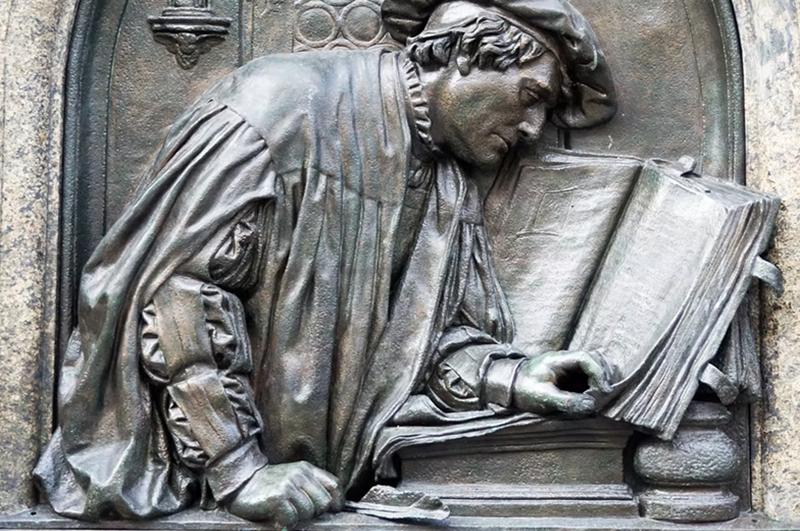
The author of the Confession of Faith, Guido de Bres, informs us that the Bible "was not delivered by the will of man", but that holy men of God were moved by the Holy Spirit to perform this work. "For the prophecy came not in old time by the will of man: but holy men of God spake as they were moved by the Holy Ghost." (2 Peter 1:21). Thus the Word of God was spoken at first; later on it was written down in a Book. The Lord used different people for this work; some of these people wrote about events that they had not seen themselves. Moses, for example, wrote the history of Paradise, the creation, and the fall of man, although Moses lived about 2500 years after the creation. The writers of the Bible could not make mistakes because they were led by the Holy Spirit. You know now that there has not always been the written Word of God which we have today. How then did the Lord reveal His will to the people in those earlier times?
In those days the Lord used different ways to make known His will to man. We will mention a few of the ways that we find in the Bible.
- By visions: while awake, some were in a trance and have heard and seen things. Thus the prophet Isaiah saw the Lord sitting on His throne, with the angels before Him. Also, while Peter was on the roof of the house, he saw in a vision the sheet with unclean beasts, instructing him regarding the three men who would come to him from Cornelius. In both of these visions the Lord called His servants to special tasks. We also know of the visions of Zechariah, in which the Lord revealed important promises to Israel if they would obey His Law, but also punishments if they would not listen to His Word. The things seen in these visions was told to the people.
- By dreams: sometimes the Lord revealed His will to His servants while they were sleeping. When Jacob was in Bethel he dreamed, and saw a ladder reaching from the earth to heaven with the angels of God moving up and down upon it. This ladder was a type of the Lord Jesus, Who would restore the communion between God and the elect sinners. Also wicked men such as Nebuchadnezzar and the Pharaoh of Egypt received the Word of God in this way.
- By spoken words: God also communicated by verbal language. Samuel heard the voice of the Lord calling him three times. There is also the internal calling in the conscience as we read in 2 Samuel 23:2, "The Spirit of the Lord spake by me, and His word was in my tongue."
- By appearances of the Lord and of His angels. The Lord came to Abraham while he was sitting in his tent door, and shortly thereafter informed him that the five cities would be destroyed. The Lord sent His angel as His messenger to Elijah when he fled from Ahab and Jezebel. The angel of the Lord awoke him, gave him food and drink, and also encouraged him.
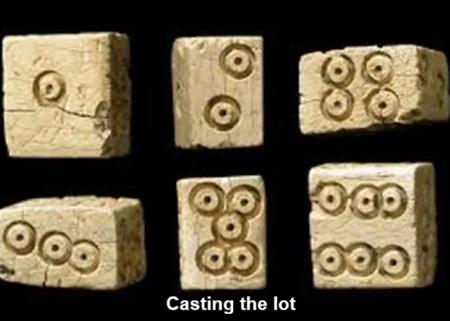
- By casting the lot. In this way Achan, after he had stolen of the spoil of Jericho, was pointed out as the man who troubled Israel. In the same supernatural way Saul was shown to be the Lord's appointed one as King over Israel, even though anointed previously by Samuel. First the tribe of Benjamin was taken, then the family of Matri from among them, and finally Saul, who had hid himself among the stuff. In this way the Lord made known His will to His people.
- By Urim and Thummim: this is closely related to the previous way. In Exodus 28:30 we read, "Thou shalt put in the breastplate of judgment the Urim and the Thummim." We don't know exactly what these have been, but were used to ask counsel of the Lord. Some think they were a white stone and a black stone, which would indicate the guilty party. But David also asked the Lord's counsel through the priest by the Urim and Thummim as to what he should do. The literal meaning of these words is lights and perfections. These mysterious contents of the breastplate seem to direct our thoughts to the heart of the Lord Jesus, as containing all light and perfections, all grace and truth, all mercies and righteousness.
In these different ways the Lord revealed His Word, which was brought to the people by His servants in verbal language. Most of those messages were not only for the people of those days, but were of importance for the church of all ages. Now we shall show how the Lord took care of this.
As we know, the church was without the written Word from Adam to the days of Moses. In those centuries the Lord maintained His Word by verbal tradition from father to son, and in this way God's Word was kept pure. Adam and Eve told their children about Paradise, the blessed state wherein they had been created, but also about the terrible state in which they had brought themselves by their disobedience. I think many tears were wept when they spoke about their former glory of the past, and about what they now were. Do we know the times when we were really unhappy because we sinned time and again against a good God? The sorrow after God is found in all those who are convinced by the Holy Spirit of their state!
To show that only a few people were necessary to keep God's Word pure during the first 2500 years, I give the following facts:
Adam became 930 years old — he lived until the year 930 (see Genesis 5).
Methuselah became 969 years old — he lived during the period 688 to 1656 — thus he lived 242 years with Adam.
Shem became 600 years old — he lived during the period 1558 to 2158 — thus he lived 98 years with Methuselah.
Isaac became 180 years old — he lived from 2108 to 2288 — thus he lived 50 years with Shem.
After this we don't know the exact dates, but Levi the son of Jacob has known his grandfather Isaac. The daughter (or granddaughter) of Levi was Jochebed, a name well known to us because she was the mother of Moses, the first writer of the Bible. In this way the Lord preserved His Word in the first 25 centuries from Adam to Moses, and only seven or eight persons were necessary for this task.
Then it became God's time that His Word be written. Today the Lord does not speak through visions, appearances, etc., but only through His Word. Therefore it is so necessary that young and old search the Word of God. He can use this to our salvation when His Spirit accompanies it; a greater treasure we can never find.
Of the Written Word of God⤒🔗
We noticed how the Lord has taken care of His Word, not only that it was spoken, but also that it was kept pure during the first centuries of the world. Why is that situation different now, and why is His Word now a written Word? Is the Lord not Almighty and thus able to take care of His Word? Yes, He is the Lord, and for Him there is nothing too wonderful — but He is also wise. We know that after the time of Noah the people did not become as old anymore as they had before the flood, and therefore the necessity that the Word is written becomes greater. A number of reasons can be given why the Lord felt that this was necessary, and we will list a few of them:
- That the Divine Revelation should not be forgotten.
- That God's Word might remain pure. The snares of Satan became more severe, but also our corrupt nature was a great danger to the purity of the Word.
- That the written Word might be more easily spread throughout the world.
- That God's special care for our salvation might be shown. Without God's Word we cannot be saved as it is used by the Holy Spirit to teach us.
- That the people through the written Word might know exactly the will of God as revealed in His Word.
- That the sinner might be warned of the punishment that will come, but also a poor sinner might find encouragement that the Lord is faithful for His children.
These reasons we find written in this third article — "And that afterwards God, from a special care which He has for us and our salvation, commanded His servants, the prophets and apostles, to commit His revealed Word to writing."
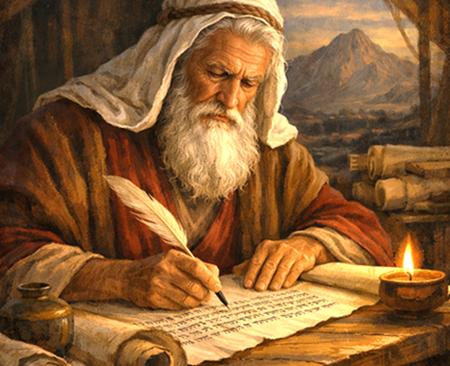
The first writer of God's Word was Moses, who lived about 2500 years after the creation; the last writer was John on the isle of Patmos, who died about 96 years after Christ. There is a space of about 1600 years between Moses and John. During that period of time the Lord enabled some of His servants to write His Word, which He wanted to use in the following centuries for the benefit of His church. During the Old Testament times those servants were the prophets and in the days of the New Testament they were the apostles and evangelists.
You must understand that not every word which was spoken by God's servants was written in the Bible. Many things had value only for that moment when they were spoken to a special person or group of people, and not for the church in general. Thus it is in the wisdom of the Lord that those things are written which we find in the Bible, and other things were left out by Him. We know that the Bible contains 66 books, each quite different from the others, and yet it is the Word of God from the beginning to the end. In them is not only spoken of God and His worship, but also of worldly and natural things. The way in which it is written shows that this Book is different than other books and that it has a higher origin.
What is this higher origin? It is written by the inspiration of the Holy Ghost. But this is not without God the Father, nor without God the Son, Who is also called the Word. The apostle Paul says of the inspiration: "The holy men of God spake as they were moved by the Holy Ghost" (2 Peter 1:21). How can we explain the inspiration? Some think that this has been a mechanical inspiration, that these men have been as a machine, a will-less instrument, in the hand of the Holy Spirit. Our Reformed fathers have always denied this; instead they spoke about an organic inspiration, meaning that the Holy Spirit made use of men — holy men — but as rational and moral beings. The thoughts of God were inspired in their minds, but this did not wipe out their human nature. The Holy Spirit made use of their natures and minds, but it was under the leading of the Spirit. These holy men themselves searched out, thought, spoke, and wrote the Word, but the Holy Spirit led them in all truth so that they could not err in their writings. At the beginning of Luke 1 we find it clearly stated that the human mind was used — "It seemed good to me also, having had perfect understanding of all things from the very first, to write unto thee in order, most excellent Theophilus."
The best proof of the organic inspiration is the different styles of the writers, according to character, understanding, talent, education, etc. By this we see that the whole personality, with its gifts and talents, are useful in this work. Although there were many differences among the writers, it was the same Spirit that urged them to write and gave His leading. This writing was not accidental nor against their will, as the Lord inclined their heart for it. Sometimes the Lord gave them an express command to do so, as with Moses and John, but probably not always in this same way. All the words in the Bible are not spoken by God, but some also by men and some even by Satan. Sometimes very wicked things are described in order to warn us from doing the same, for the Lord will surely punish us if we do so.
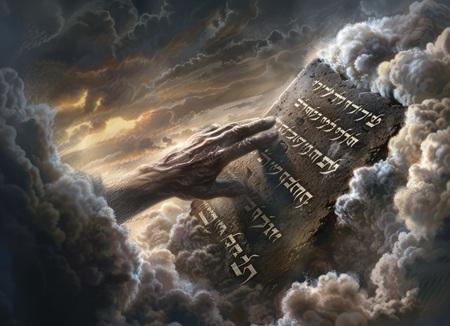
A part of the Bible was written by the Lord Himself, namely, the Holy Law on Mount Sinai. The Lord had first spoken these words unto Israel, and afterwards wrote them upon the two tables of stone. Why did the Lord write this with His own finger?
- To teach that the Law is of higher authority than all human writings.
- To make it very clear that we must hearken to the Law of God.
- To show that it is an eternal Law which shall never end, just as stone endures for ever (from a human viewpoint).
- To signify that it is the Lord Who writes the Law in the hearts of the elect, which never can be destroyed by Satan.
You will perhaps ask why the tables of stone were written upon both sides. It was to prevent the possibility of something being added or erased from the Law. It is our duty to hearken especially to these words of God, but also to the entire Bible, as it is also God's Word, and is valid until the end of the world. We all know that the Bible is old — almost 2500 years old — but it is not old-fashioned. By it we can become wise for eternity.
The Bible is not only for Israel, but for all nations. It does not begin with the history of Israel, but with the history of creation. It does not end when Israel is no longer a theocracy, but it ends with the new heaven and earth. This shows its international character. Its main content is Christ, both in the Old and New Testament. When we see the sun, then we must acknowledge its existence and glory: likewise when we read the Bible, then we see Its Divine origin and holiness.
As it is the only means which is used by the Lord to our salvation, it is worthy to be searched by young and old, with the prayer in our hearts and on our lips that the Lord may use it for that purpose, even though we have forfeited all blessings for time and eternity.
Add new comment